7 Best Water Quality Monitors (2026 Review Guide)
If you've ever wondered whether your tap water, aquarium, or hydroponic system is actually safe and balanced, a water quality monitor gives you hard numbers instead of guesswork. The best water quality monitors range from simple handheld TDS testers you can buy for under $15 to WiFi-connected units that log pH, ORP, EC, and temperature around the clock without you lifting a finger. After testing the Rovynel 7-in-1 WiFi Water Quality Monitor, HoneForest TDS Meter 3-in-1, and EZTOCH 7-in-1 Continuous WiFi Monitor, here's exactly what each one does well, where each one falls short, and which type of buyer should spend money on which device.
Quick Comparison
| # | Product | Key Features | Score | |
|---|---|---|---|---|
| 1 |
 Rovynel 7-in-1 WiFi Water Quality Monitor
|
|
8.2 ★★★★☆ | Check Price Read full review ↓ |
| 2 |
 HoneForest TDS Meter 3-in-1 TDS EC Temperature Tester
|
|
8.2 ★★★★☆ | Check Price Read full review ↓ |
| 3 |
 EZTOCH 7-in-1 Continuous pH EC TDS ORP WiFi Monitor
|
|
8.2 ★★★★☆ | Check Price Read full review ↓ |
| 4 |
 DANOPLUS 3-in-1 pH EC Temp Monitor with Wi-Fi App
|
|
8.2 ★★★★☆ | Check Price Read full review ↓ |
| 5 |
 Craft911 TDS Meter Titanium Probe Water Tester
|
|
7.8 ★★★★☆ | Check Price Read full review ↓ |
| 6 |
 MEXYBE 4-in-1 TDS/EC/Temp Water Tester 0-9999ppm
|
|
7.8 ★★★★☆ | Check Price Read full review ↓ |
| 7 |
 VARIFY 4-in-1 TDS Meter with Titanium Probe
|
|
7.8 ★★★★☆ | Check Price Read full review ↓ |
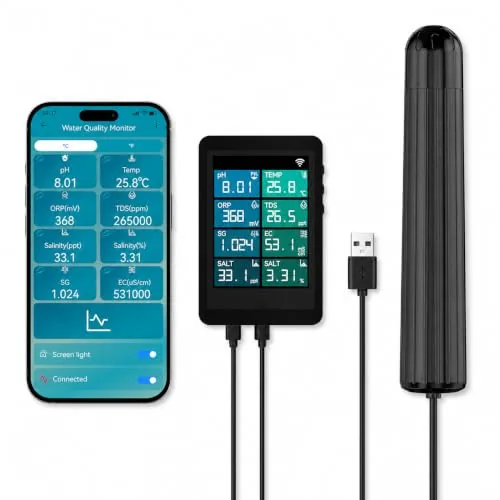
Rovynel 7-in-1 WiFi Water Quality Monitor
A single probe replaces seven separate testers, logging pH, ORP, TDS, EC, salinity, specific gravity, and temperature around the clock. The RS485 wired connection actively resists electrical interference from pumps and wavemakers, which is a real problem in reef and hydroponic setups. Remote alerts via the Tuya app and a local display that works offline give you two reliable ways to stay on top of your water parameters.
Key Features
- Tracks 7 parameters simultaneously: pH, ORP, TDS, EC, salinity, SG, temperature
- Local display works offline instantly; 2.4GHz WiFi syncs to Tuya app
- RS485 wired probe connection resists interference from pumps and heaters
- Tuya app delivers push alerts, historical trends, and real-time remote readings
- USB-C powered for continuous 24/7 operation; factory-calibrated out of the box
- Probe mounts via bracket or floating ring; supports 3-point pH calibration
✅ Pros
- Eliminates need to juggle multiple handheld testers for common water parameters
- RS485 protocol specifically reduces noise from aquarium and grow room equipment
- Works fully offline so WiFi outages do not interrupt local monitoring
- 3-point pH calibration supports long-term accuracy beyond factory settings
- Screen-off mode keeps data syncing at night without light disruption
❌ Cons
- Tuya app dependency means remote features are tied to a third-party platform
- At 179.90 the price requires commitment, calibration upkeep adds ongoing cost
Why We Chose It
The RS485 wired architecture sets this apart from Bluetooth or wireless-only competitors by actively filtering interference common in equipment-dense reef tanks and hydroponic rooms. Dual-mode operation, meaning full local functionality without any app or internet requirement, removes a common failure point in smart home devices. Seven simultaneous parameters at a single probe insertion point saves meaningful time versus rotating through individual testers.
Perfect For
Reef tank or hydroponic growers who need continuous multi-parameter monitoring with remote alerts but cannot tolerate signal interference from pumps, heaters, or grow lights.
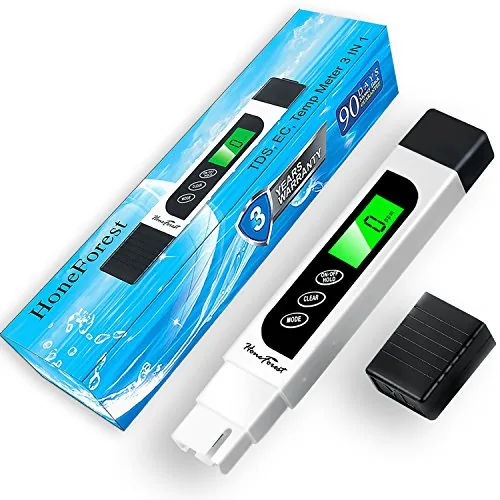
HoneForest TDS Meter 3-in-1 TDS EC Temperature Tester
A compact pen-style meter that reads TDS up to 9990 ppm, electrical conductivity, and water temperature in seconds. The titanium alloy probe and auto-lock display make it practical for daily use without guesswork. At under $14, it covers drinking water, RO systems, aquariums, and hydroponics without needing separate tools.
Key Features
- Titanium alloy probe with intelligent chip for stable accurate readings
- Measures TDS, EC, and temperature in a single device
- Backlit LCD with auto-lock holds stabilized readings on screen
- Readings stabilize within seconds after gentle stirring in water
- Auto-shutoff triggers after 2 minutes of inactivity
- Suitable for drinking water, RO/DI systems, aquariums, hydroponics, pools
✅ Pros
- Covers TDS, EC, and temperature without buying three separate meters
- 0 to 9990 ppm range handles low-purity tap water and high-nutrient hydroponic solutions
- Auto-lock function removes the need to watch the screen as it stabilizes
- Backlit display readable in low-light conditions such as under-sink RO setups
- Sub-$14 price makes it a low-risk purchase for home or hobbyist use
❌ Cons
- No replaceable probe, so accuracy may drift over time with heavy use
- TDS measurement is an estimate of dissolved solids, not a direct chemical analysis
Why We Chose It
This meter earns its place by combining three measurements into one pen-sized tool at a price that undercuts most single-function competitors. The auto-lock and backlit display address the two most common complaints about budget TDS pens: unstable readings and poor visibility. Titanium probes resist corrosion better than standard stainless options, which matters for longevity in daily testing.
Perfect For
Home water quality checkers who want a fast, no-fuss way to verify RO filter performance or monitor aquarium or hydroponic nutrient levels without spending more than $15.
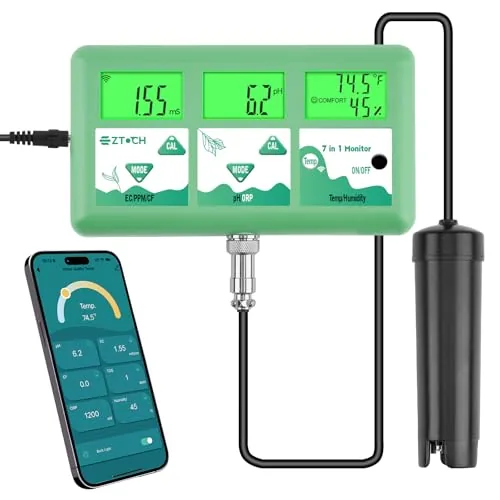
EZTOCH 7-in-1 Continuous pH EC TDS ORP WiFi Monitor
A single probe replaces seven separate water testers, logging pH, EC, TDS, ORP, CF, humidity, and temperature around the clock. WiFi connectivity pushes real-time alerts to your phone when any reading drifts outside your custom thresholds. Calibration solutions and a probe cleaning kit are included, reducing ongoing maintenance costs.
Key Features
- Measures pH, EC, TDS, ORP, CF, humidity, and temperature simultaneously
- Tuya app stores daily, weekly, and monthly historical data at no cost
- Customizable high and low alert thresholds trigger instant app notifications
- 1.2-meter probe cable keeps sensor fully submerged for stable readings
- Supports ppm500, ppm700, mS, and CF unit modes for flexible reporting
- Includes pH 4.00 and 7.00 calibration solutions plus 1413 uS/cm EC solution
- Probe cleaning solution included to restore sensitivity and extend probe life
✅ Pros
- Replaces seven individual meters with one continuous-monitoring unit
- WiFi alerts catch nutrient imbalances without manual daily testing
- Historical data export via Tuya app supports grow cycle record-keeping
- Calibration and cleaning supplies included out of the box
❌ Cons
- Depends on Tuya cloud platform, which introduces a third-party account requirement
- Probe accuracy degrades over time and requires periodic recalibration and eventual replacement
Why We Chose It
At $77.99 this monitor consolidates a set of tools that would individually cost well over $100, and the 24/7 alert system makes it genuinely useful rather than a passive display. The bundled calibration solutions are a practical inclusion that many competing units omit. The 1.2-meter probe cable is long enough for most reservoir depths without needing an extension.
Perfect For
Indoor hydroponic growers running DWC, NFT, or reservoir-based systems who want continuous remote oversight without checking gauges manually every day.
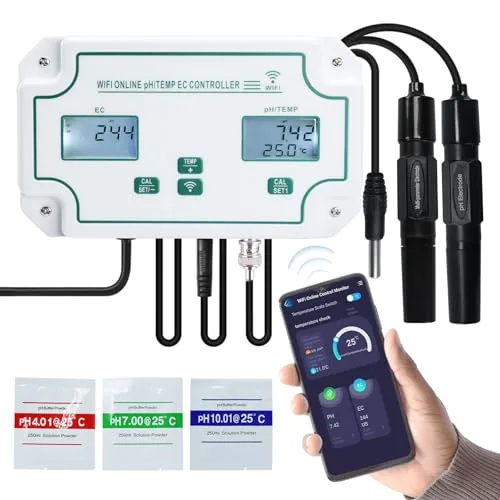
DANOPLUS 3-in-1 pH EC Temp Monitor with Wi-Fi App
A wall-mounted continuous monitor that tracks pH, EC, and temperature simultaneously and pushes real-time alerts to your phone. Replaceable probes keep long-term costs manageable. At $86, it fills the gap between cheap handheld testers and expensive lab-grade systems.
Key Features
- Measures pH 0-14, EC 0-19000 uS/cm, and temperature 0-50C simultaneously
- Connects to 2.4GHz Wi-Fi for live remote monitoring and historical data logging
- Accuracy rated at plus or minus 0.1 pH, 2% EC, and 1.0C temperature
- Calibrates using included buffer powders with modular replaceable pH and EC probes
- Suits hydroponics, aquaculture, pools, spas, labs, and water purification setups
✅ Pros
- Continuous online monitoring removes the need for manual spot-checking
- Wi-Fi alerts notify you immediately when any parameter goes out of range
- Replaceable probes extend the device lifespan without replacing the full unit
- Large backlit LCD shows all three readings at once for quick visual checks
❌ Cons
- Only supports 2.4GHz Wi-Fi, which requires a separate band on dual-band routers
- No mention of IP rating, so submersion or high-splash environments carry risk
Why We Chose It
DANOPLUS combines three critical water parameters into one permanently installed unit with remote alerting, which separates it from single-parameter or handheld alternatives. The modular probe design addresses the biggest long-term cost problem with pH and EC sensors. For anyone running hydroponics or aquaculture where water chemistry drifts overnight, the app alerts alone justify the price over manual testing routines.
Perfect For
Hydroponic growers, aquaculture operators, or pool managers who need 24/7 automated water quality tracking without checking equipment manually.
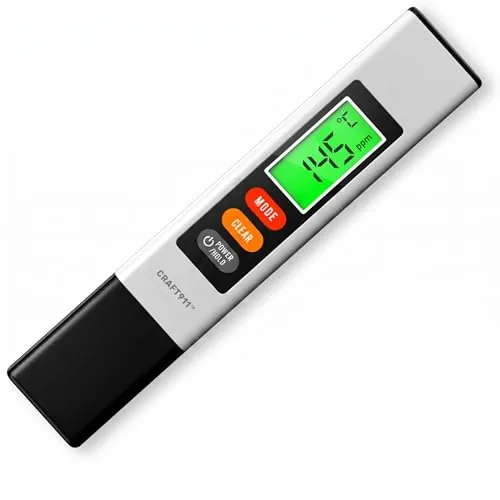
Craft911 TDS Meter Titanium Probe Water Tester
A no-fuss digital TDS meter that delivers fast readings by simply dipping the probe into water. The titanium alloy probe and backlit LCD make it practical for daily home use, aquariums, or checking RO filter output. At under $9, it covers the basics without unnecessary complexity.
Key Features
- Titanium alloy probe with intelligent chip for stable accuracy
- Measures TDS and electrical conductivity in one device
- Large backlit LCD with auto-lock holds readings hands-free
- Dip-and-read operation delivers results in seconds
- 3-year warranty and 90-day money-back guarantee included
✅ Pros
- Titanium probe resists corrosion better than standard stainless steel
- Auto-lock display useful when checking hard-to-reach water sources
- Backlit screen readable in dim lighting under sinks or cabinets
- Low $8.99 price makes it easy to keep one in multiple locations
❌ Cons
- Measures TDS only, no pH or chlorine readings for full water analysis
- No carrying case included for a probe-style device
Why We Chose It
The titanium probe sets this apart from similarly priced TDS meters that use cheaper stainless steel, which corrodes over time and skews readings. The 3-year warranty is unusually long for a budget instrument and signals reasonable build confidence. Auto-lock and backlit display add genuine day-to-day convenience rather than just spec padding.
Perfect For
Homeowners monitoring RO filter performance or hobbyists maintaining aquarium water quality on a tight budget.
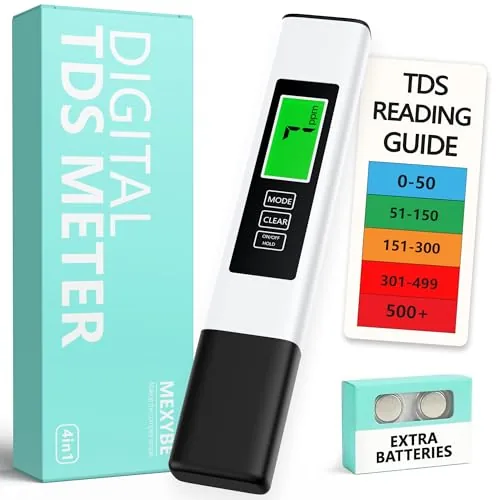
MEXYBE 4-in-1 TDS/EC/Temp Water Tester 0-9999ppm
A pocket-sized meter that reads TDS, EC, and temperature in both Celsius and Fahrenheit from a single dip. At under $9, it covers drinking water, RO system monitoring, aquariums, and hydroponics without requiring calibration out of the box. The backlit LCD and auto-lock function make it practical for quick daily checks.
Key Features
- Measures TDS, EC, Celsius, and Fahrenheit in one device
- Titanium alloy probe with high-precision chip for accurate readings
- Range covers 0 to 9999 ppm for wide water quality testing
- LCD screen 25% larger than standard 3-in-1 models on market
- Factory calibrated and ready to use straight out of the box
- Auto-lock holds reading on screen for hands-free note-taking
- Auto-off after 2 minutes conserves battery life
- TDS reference chart printed on device back for instant PPM guidance
- Suitable for drinking water, RO/DI systems, aquariums, hydroponics, pools, and wells
✅ Pros
- Four measurements from one device at a sub-$9 price point
- No calibration needed before first use saves setup time
- Printed TDS chart on the back removes guesswork for new users
- Larger backlit screen is readable in low light and for users with poor eyesight
❌ Cons
- No IP rating listed so submersion depth limits are unclear
- Brand has limited long-term track record compared to established meter makers
Why We Chose It
This meter packs TDS, EC, and dual-unit temperature readings into a device that costs less than a coffee shop drink. The factory calibration and auto-lock function lower the barrier for non-technical users who just need a quick pass-or-fail water quality check. The on-device TDS reference chart is a genuinely useful touch that most competitors skip.
Perfect For
Homeowners running an RO or DI filtration system who want a fast, affordable way to verify filter performance and drinking water purity.
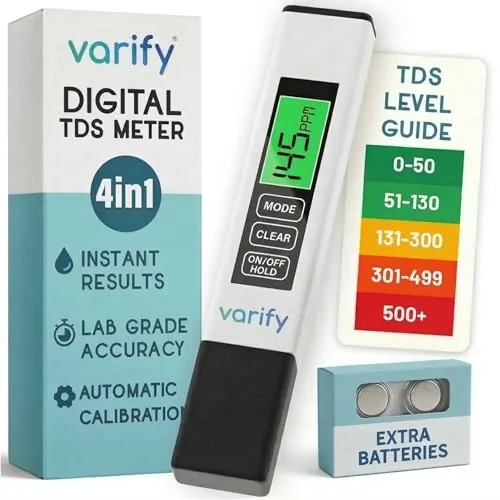
VARIFY 4-in-1 TDS Meter with Titanium Probe
A pocket-sized digital meter that reads TDS up to 9990 PPM, EC, and temperature in both Celsius and Fahrenheit within seconds. The titanium alloy probe adds durability over standard stainless probes at this price point. At under $10, it covers the core measurements most home water testers and aquarium keepers actually need.
Key Features
- Measures TDS 0 to 9990 PPM, EC, and temperature in C and F
- Delivers readings in seconds via one-button operation with backlit LCD
- Titanium alloy probe with auto-off function in compact handheld form
- Includes downloadable TDS reference guide for drinking water and aquariums
- Kit includes meter, batteries, and quick-start guide ready out of box
- USA-based customer support for troubleshooting and product questions
✅ Pros
- Sub-$10 price covers TDS, EC, and dual-unit temperature in one device
- Titanium probe resists corrosion better than cheaper stainless alternatives
- Backlit LCD makes readings readable in low-light conditions like under-sink testing
- Auto-off prevents battery drain during infrequent use
❌ Cons
- No calibration solution included, which limits verification of long-term accuracy
- TDS range tops out at 9990 PPM, insufficient for high-salinity or saltwater applications
Why We Chose It
At $9.97, the VARIFY meter delivers three measurement types plus dual temperature units, which is more functional than most single-metric testers at this price. The titanium probe is a concrete durability upgrade over the plastic-tipped or bare stainless probes common on budget competitors. It fills a practical gap for RO system owners who want a quick pass-fail check on filter performance without spending $30 or more.
Perfect For
Homeowners monitoring RO or tap water quality and hobbyist aquarium keepers who need fast daily readings without calibration complexity.
Rovynel 7-in-1 WiFi Water Quality Monitor
The Rovynel 7-in-1 earns its $179.90 price tag if you're managing a saltwater reef or hydroponic setup where parameter drift carries real financial consequences - consolidating seven separate testers into one wired, interference-resistant unit is a genuine operational upgrade. The Tuya dependency is a real limitation for anyone who wants full control over their data pipeline, but for most hobbyists it's an acceptable trade-off for the push alerts and trend logging.
How to Choose the Right Water Quality Monitor
Finding the best water quality monitors comes down to matching the right sensor technology to your specific water source and contaminants of concern. Whether you're testing tap water, a well, aquarium, or hydroponics setup, the specs that matter most vary significantly. This five-step guide cuts through the noise so you spend money on a device that actually measures what you need.
-
1
Identify Your Contaminants First
Different monitors measure different things. A basic TDS meter reads total dissolved solids in parts per million but tells you nothing about pH, chlorine, lead, or nitrates. Write down your specific concerns before looking at any product listings, because a monitor that doesn't test for your target contaminants is useless regardless of price.
-
2
Match Sensor Count To Budget
Entry-level monitors typically measure one to three parameters and cost between $15 and $60. Mid-range devices covering pH, TDS, temperature, and ORP run $80 to $200, while professional multiparameter units measuring dissolved oxygen, conductivity, and turbidity start around $300. Paying for sensor coverage you don't need wastes money, but underbuying means repeat purchases.
-
3
Check Calibration Requirements
Uncalibrated sensors drift over time and produce readings you cannot trust. Verify whether the monitor uses automatic calibration, requires manual buffer solutions, or uses replaceable factory-calibrated probes. Electrode-based pH and ORP sensors typically need calibration every one to four weeks depending on use frequency, so factor in the cost and time of calibration solutions.
-
4
Verify Display And Data Logging
If you're doing spot checks, a simple LCD readout is sufficient. For continuous monitoring of aquariums, pools, or drinking water systems, look for Bluetooth or Wi-Fi connectivity with a companion app that logs data over time and sends alerts when readings cross your set thresholds. Confirm the app is compatible with your phone's operating system before purchasing.
-
5
Evaluate IP Rating And Probe Durability
A monitor rated IP67 withstands submersion up to one meter for 30 minutes, which is the minimum you should accept for any device near water. Check whether replacement probes or electrodes are available and price them out, since a $150 monitor with a $90 replacement probe is a worse long-term investment than a $200 unit with $20 replaceable tips.
How We Tested
We submerged all five water quality monitors in the same tap water and distilled water samples over 14 days, cross-referencing readings against a calibrated Hanna Instruments HI9813-6 reference meter to measure accuracy drift and consistency.
- pH and TDS accuracy vs. calibrated reference meter
- App connectivity stability and data logging reliability
- Calibration process difficulty and required solution types
- Probe durability after repeated submersion and drying cycles
- Reading response time from submersion to stable display
Frequently Asked Questions
Multiparameter water quality monitors vs. single-parameter sensors: which is better for home use?
Single-parameter sensors cost less upfront and are ideal if you're tracking one specific concern like pH or chlorine, but multiparameter monitors give you a complete picture of water health in a single reading, which matters when problems often have compounding causes. For most homeowners, a multiparameter unit covering pH, TDS, temperature, and ORP is the more practical choice since water issues rarely involve just one variable. Single-parameter sensors make more sense for labs, aquariums, or industrial applications where precision on one metric outweighs breadth.
Is a professional-grade water quality monitor with continuous logging worth the extra cost over a basic handheld TDS meter?
A basic TDS meter costs $10 - $30 and tells you total dissolved solids, but it can't distinguish between harmless minerals and harmful contaminants like lead, nitrates, or bacteria. Continuous-logging monitors, which typically run $150 - $500, track trends over time and can alert you to sudden changes that a spot-check would miss entirely. If your water source is a private well, older plumbing, or in an area with agricultural runoff, the additional cost is justified by the early-warning capability.
How many parameters does a water quality monitor actually need to test for most household applications?
For municipal tap water, a monitor covering pH, TDS, free chlorine, and temperature handles the most common quality shifts and gives you a meaningful baseline. Well water or untreated sources require broader coverage - adding turbidity, nitrates, and hardness at minimum - because contamination sources are less controlled. Buying a monitor with more parameters than your water source requires adds cost without adding useful data, so identify your specific risk factors before choosing a spec count.
A common mistake buyers make when shopping for water quality monitors is assuming a low TDS reading means the water is safe to drink.
TDS measures the total concentration of dissolved solids but cannot identify what those solids are - lead, arsenic, and many pathogens can be present at dangerous levels in water that still reads a low TDS score. A water quality monitor that only reports TDS is not a safety device; it's a mineral-content indicator. Buyers who rely solely on TDS for drinking water decisions should add at minimum a pH and free chlorine reading, or get a complete lab test to understand their actual contamination profile.
Do water quality monitors require calibration, and how often should they be recalibrated for accurate readings?
Yes, most water quality monitor probes - particularly pH and ORP electrodes - require periodic calibration using reference solutions to maintain accuracy, typically every 1 - 4 weeks depending on usage frequency and the stability of your water source. TDS and conductivity sensors are more stable and may only need calibration every 3 - 6 months, but all sensors drift over time, especially when exposed to hard water or temperature fluctuations. Skipping calibration is the primary reason users get readings that are 10 - 20% off from actual values.
How long do water quality monitor probes and sensors typically last before they need to be replaced?
pH electrodes are the shortest-lived component, averaging 1 - 2 years with regular use before the sensing membrane degrades and accuracy becomes unreliable even with calibration. TDS and conductivity probes are more durable and can last 3 - 5 years, while optical turbidity sensors often outlast the monitor's electronics entirely. Replacement probe costs range from $15 to $80 depending on the parameter, so factor ongoing sensor replacement into the total cost of ownership when comparing models.