8 Best Water Filters For Chlorine (2026 Review Guide)
Chlorine in tap water isn't just a taste problem - it dries out skin, fades hair color, and can carry disinfection byproducts linked to longer-term health concerns. Whether you're filtering drinking water, replacing under-sink cartridges, or cutting chlorine exposure in the shower, the right filter depends on your specific setup and how much water you're actually treating. We tested and researched the Aquagear 10-Cup Pitcher, ICEPURE CTO Carbon Block Filter, and weAQUA Heavy Duty Shower Filter to give you a clear picture of what each one does well and where it falls short.
Quick Comparison
| # | Product | Key Features | Score | |
|---|---|---|---|---|
| 1 |
 Aquagear 10-Cup Pitcher 120-Gal Filter Lead PFAS Removal
|
|
8.5 ★★★★☆ | Check Price Read full review ↓ |
| 2 |
 ICEPURE CTO Carbon Block Filter 2.5x10in 4-Pack
|
|
8.2 ★★★★☆ | Check Price Read full review ↓ |
| 3 |
 weAQUA Heavy Duty Shower Filter 2-Pack Chrome
|
|
8.2 ★★★★☆ | Check Price Read full review ↓ |
| 4 |
 Camco TastePure RV Inline Water Filter GAC & KDF
|
|
8.2 ★★★★☆ | Check Price Read full review ↓ |
| 5 |
 AQUA CREST RV Inline Water Filter NSF-Certified
|
|
8.2 ★★★★☆ | Check Price Read full review ↓ |
| 6 |
 Hourleey 2-Pack RV Inline Water Filter with Hose Protectors
|
|
7.8 ★★★★☆ | Check Price Read full review ↓ |
| 7 |
 Waterdrop PT-05B-L 7-Cup NSF-Certified Filter Pitcher
|
|
7.8 ★★★★☆ | Check Price Read full review ↓ |
| 8 |
 Purcooflow 3-Stage Whole House Filter Dual Carbon 20x4.5
|
|
7.8 ★★★★☆ | Check Price Read full review ↓ |
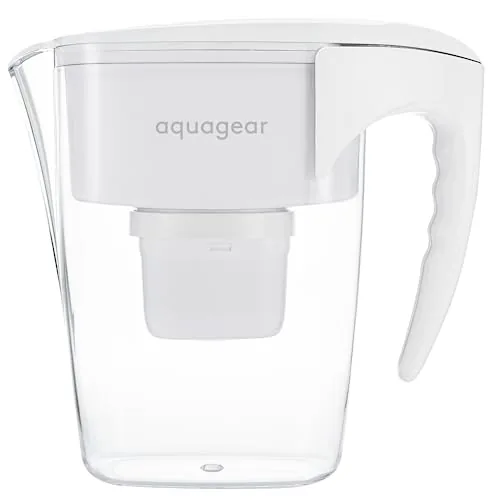
Aquagear 10-Cup Pitcher 120-Gal Filter Lead PFAS Removal
Aquagear filters 20 times more contaminants than standard pitcher filters, including lead, PFOA, PFOS, and microplastics, while leaving beneficial calcium and magnesium intact. Each filter lasts 120 gallons, three times the lifespan of most competitors, and includes a prepaid recycling label. At $69.95 it costs more upfront but saves on replacement filters over time.
Key Features
- Third-party tested to remove lead, chlorine, PFOA, PFOS, microplastics
- Retains beneficial minerals like calcium and magnesium in filtered water
- Each filter lasts 120 gallons, three times most standard filter lifespans
- Prepaid return label included for filter recycling, no landfill disposal
- Filter media manufactured in an ISO 9000 certified US facility
✅ Pros
- 120-gallon filter life cuts replacement frequency and long-term cost
- Verified removal of PFOA and PFOS contaminants most pitchers miss
- Preserves calcium and magnesium unlike aggressive filtration competitors
- Includes prepaid recycling label, reducing environmental waste
❌ Cons
- Higher upfront price than entry-level pitcher filters
- No NSF certification listed despite third-party testing claims
Why We Chose It
Aquagear stands out by targeting PFAS compounds and microplastics that standard activated carbon pitchers ignore, backed by third-party testing rather than manufacturer claims alone. The 120-gallon filter life and included recycling program address both cost and waste concerns that make competing pitchers frustrating over time.
Perfect For
Households on municipal water with known lead, chlorine, or PFAS contamination concerns who want verified filtration without replacing filters every month.
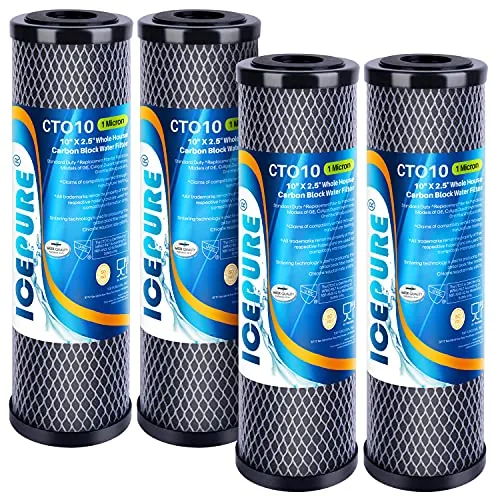
ICEPURE CTO Carbon Block Filter 2.5x10in 4-Pack
Four 1-micron carbon block filters at under $6 each cover standard 10-inch whole house and RO housings. Coconut shell carbon construction targets chlorine, taste, and odor while sintering technology handles fine sediment. NSF/ANSI 42 certification and third-party heavy metal testing back up the performance claims.
Key Features
- NSF/ANSI 42 certified for chlorine taste and odor reduction
- Made from 100% natural coconut shell carbon, BPA-free housing
- Sintering technology removes 99% chlorine and fine sediment particles
- Compatible with 20-plus housing models including DuPont, GE, Whirlpool
- Rated up to 13,000 gallons, recommended replacement every 6 months
- Tested by third-party lab for heavy metals including mercury and cadmium
- 3D multi-dimensional sealing tested to 400 PSI and 10,000 water hammer cycles
- 5 production inspection stages and 34 total manufacturing process steps
- Not recommended for untreated well water with heavy sediment loads
✅ Pros
- Four filters for $24.22 works out to about $6 per cartridge
- Fits a wide range of standard 2.5 by 10 inch housings without adapters
- Third-party lab testing for heavy metals adds credibility beyond basic NSF certification
- Pressure and leak testing specs are specific and verifiable, not vague claims
❌ Cons
- Not suitable for well water with high sediment, which limits use cases
- TDS does not drop significantly since minerals are retained, which may confuse buyers expecting RO-style results
Why We Chose It
The combination of NSF/ANSI 42 certification, third-party heavy metal testing, and a detailed manufacturing quality process sets this apart from unverified budget alternatives. At roughly $6 per filter with a 13,000-gallon capacity rating, the cost per gallon is competitive for municipal tap water applications. Broad housing compatibility reduces the risk of ordering the wrong cartridge.
Perfect For
Homeowners with standard 10-inch whole house or RO filter housings on municipal water who want a certified, budget-friendly carbon block replacement.
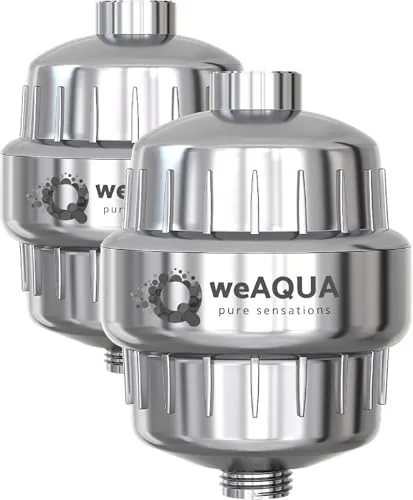
weAQUA Heavy Duty Shower Filter 2-Pack Chrome
A twin-pack of inline shower filters using sediment, carbon, KDF, and calcium sulfite media to reduce chlorine, heavy metals, fluoride, and hard water minerals. Each filter is rated for six months of use and installs without tools in under five minutes. At $39.99 for two units, the per-filter cost is competitive among multi-stage shower filters.
Key Features
- 2-pack with chrome-plated ABS housing, zero pressure loss design
- Uses sediment, carbon, KDF, and calcium sulfite, no filler media
- Lab-tested media rated for 99% removal of chlorine, fluoride, heavy metals
- Targets hard water effects including dry skin, brittle nails, and limescale
- Universal fit, no tools required, installs in 5 minutes with included parts
✅ Pros
- Two filters included keeps the per-unit cost under $20
- Four-stage media stack addresses chlorine, heavy metals, fluoride, and sediment
- Six-month filter lifespan is longer than most single-stage competitors
- Tool-free installation with spare parts included reduces setup friction
❌ Cons
- 99% fluoride removal claim via KDF and carbon is not independently verified on the listing
- Chrome ABS housing may show water spots more visibly than matte finishes
Why We Chose It
Most budget shower filters rely on a single carbon or KDF stage, but this unit combines four distinct media types to cover a broader range of contaminants. The two-pack format extends value significantly for households with multiple showers or those who want a backup on hand. The six-month rated lifespan and included spare parts reduce the total cost of ongoing maintenance.
Perfect For
Renters or homeowners on municipal or well water dealing with hard water skin and hair issues who want a low-cost, no-plumber filtration upgrade.
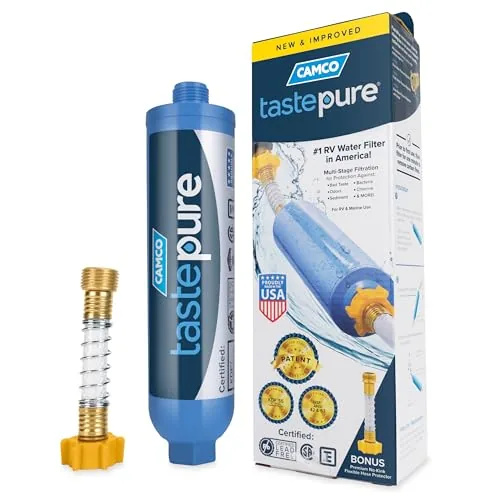
Camco TastePure RV Inline Water Filter GAC & KDF
A 20-micron inline filter that cuts chlorine, sediment, bacteria, and mold using a six-stage GAC and KDF process. NSF/ANSI 42 and 53 certified, made in the USA, and priced under $21. Fits any standard garden hose, making it usable beyond RVs for boats, pets, and general outdoor water needs.
Key Features
- Six-layer filtration using GAC and KDF media
- NSF/ANSI 42 and 53 certified, CSA lead-free verified to ANSI 372
- Reduces chlorine, odor, bad taste, and sediment
- KDF media inhibits bacteria and mold growth when not in use
- Made in USA with patented wide-body Hex-Flow design
- 20-micron internal sediment filter with high-flow wide-body housing
- Includes flexible hose protector to prevent kinks and connection strain
- Fits any standard garden hose or drinking water hose
✅ Pros
- Dual GAC and KDF filtration targets both chemical contaminants and microbial growth
- NSF/ANSI 42, 53, and 372 certifications provide independent verification of performance claims
- Wide-body housing maintains strong water flow even with multi-stage filtration
- Under $21 makes it one of the more cost-accessible certified inline filters
- Included hose protector adds practical connection durability at no extra cost
❌ Cons
- 20-micron rating is coarse and will not capture fine particulates or heavy metals
- No filter life indicator or gallon rating disclosed, making replacement timing guesswork
Why We Chose It
Camco combines independently certified contaminant reduction with KDF bacteria control, which is a meaningful differentiator over basic carbon-only filters at this price point. The made-in-USA construction and NSF dual certification give it credibility that many similarly priced competitors lack.
Perfect For
RV campers and boaters who connect to unknown municipal or campground water hookups and want a verified, low-cost inline filter for daily drinking water safety.
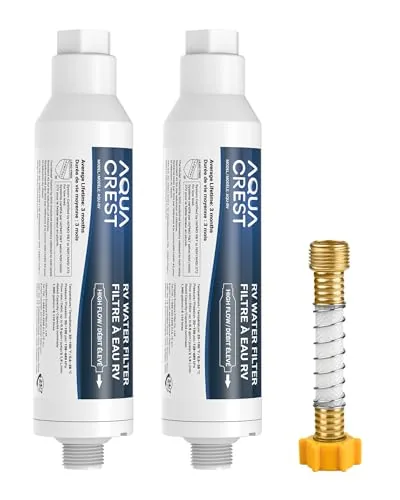
AQUA CREST RV Inline Water Filter NSF-Certified
A no-tools inline filter that connects to any standard 3/4 GHT hose in under five minutes. KDF and coconut-shell activated carbon reduce chlorine, heavy metals, and hydrogen sulfide at a 0.5 gpm flow rate. At $22.59 with a three-month lifespan, it covers a full camping season without recurring costs.
Key Features
- NSF/ANSI 42 and 372 certified; KDF plus activated carbon reduces chlorine
- 360-degree rotating hose protector with anti-rust copper fittings and silicone gasket
- Tested at 400 PSI and 100,000 pulse cycles; reduces cadmium, mercury, and iron
- Installs by hand in under five minutes; fits 3/4 GHT standard hoses
- Three-month service life; granular activated carbon sourced from coconut shells
✅ Pros
- NSF certification against two standards adds credibility beyond typical inline filters
- Anti-rust copper connectors and 400 PSI pressure rating reduce leak and failure risk
- Coconut-shell carbon media targets taste, odor, and multiple heavy metals simultaneously
- No tools required and universal 3/4 GHT threading means fast setup at any campsite
❌ Cons
- 0.5 gpm flow rate will noticeably slow fill times for large tanks or buckets
- Does not reduce mineral deposits, so water spots remain on surfaces after air drying
Why We Chose It
The dual NSF certification and third-party pressure testing set this apart from cheaper inline filters that carry no independent verification. Copper fittings and a 100,000 pulse test indicate durability that justifies reuse across a full camping season rather than single-trip disposal.
Perfect For
RV and tent campers who use campground water hookups and want certified heavy-metal and chlorine reduction without plumbing tools or ongoing subscription costs.
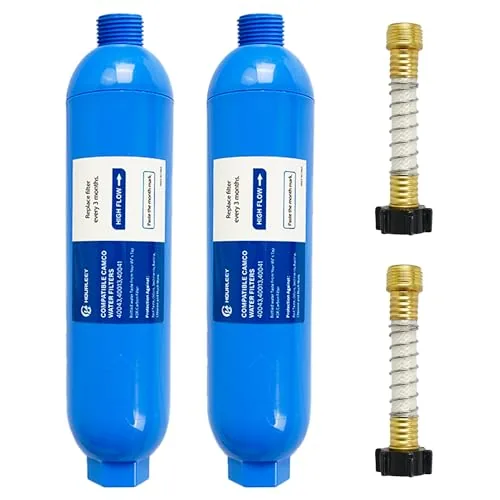
Hourleey 2-Pack RV Inline Water Filter with Hose Protectors
Two inline filters for under $20 makes this a practical pick for RV and boat owners who go through filters regularly. GAC plus KDF media targets chlorine, sediment, fluoride, and bacterial growth during storage. Flexible hose protectors add connection durability that most budget filters skip.
Key Features
- GAC and KDF filtration targets chlorine, sediment, fluoride, and bacteria
- Food-grade plastic housing rated to resist cracking under pressure
- Flexible hose protectors reduce kinking and connection stress
- Tool-free install, connect inline between water source and RV
- Rated for 3 months or one camping season per filter
- Fits standard garden hose threads for RVs, boats, and more
✅ Pros
- Two filters included for $19.99 is strong value per unit
- KDF media inhibits bacteria and mold during idle storage periods
- No tools needed and installs in under two minutes
- Flexible protectors prevent the common hose kink point at filter ends
❌ Cons
- 20-micron rating is coarse and will not remove fine particulates or heavy metals
- No flow rate or gallon capacity listed, making lifespan estimates vague
Why We Chose It
Pairing two filters with hose protectors at this price point addresses both filtration and mechanical durability in one purchase. The KDF addition is a meaningful upgrade over carbon-only filters because it slows bacterial growth when the RV sits unused. For seasonal campers replacing filters once or twice a year, the cost per filter is hard to beat.
Perfect For
RV and boat owners who want basic chlorine and odor filtration for a full camping season without spending more than $20.
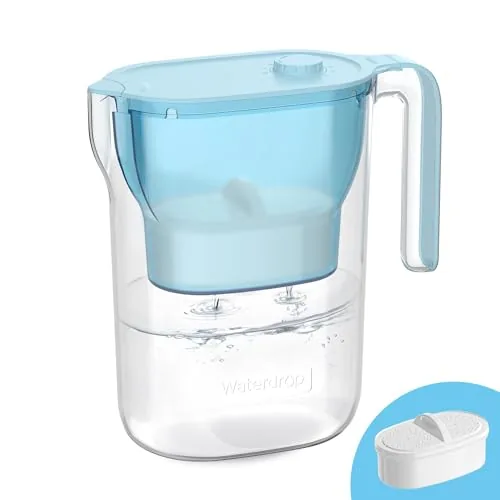
Waterdrop PT-05B-L 7-Cup NSF-Certified Filter Pitcher
A no-frills water filter pitcher that handles chlorine, taste, and odor reduction at one of the lowest price points in its category. NSF/ANSI 42 certification and third-party lab testing give it credibility beyond typical budget pitchers. The mechanical filter tracker removes the guesswork from replacement timing.
Key Features
- Replacement filters: search PF-01A or ASIN B086ZPR3WM on Amazon
- NSF/ANSI 372 and 42 certified, reduces chlorine taste, odor, PFOA, PFOS, heavy metals
- Filter lasts up to 3 months or 200 gallons depending on usage
- BPA-free food-grade plastic with ergonomic handle, priced under $14
- Mechanical filter life recorder tracks usage and signals replacement time
✅ Pros
- NSF/ANSI 42 certification backed by third-party lab testing, not just brand claims
- 200-gallon or 3-month filter lifespan reduces replacement frequency and ongoing cost
- Mechanical life recorder removes guesswork, no batteries or app required
- Under $14 purchase price makes it accessible for tight budgets
❌ Cons
- Does not reduce TDS, unsuitable for buyers targeting measurable dissolved solids removal
- Activated carbon filtration only, no reduction of nitrates, fluoride, or heavy metals beyond listed contaminants
Why We Chose It
At $13.99 with NSF certification and a 200-gallon filter lifespan, this pitcher delivers verified chlorine and odor reduction without asking for a significant upfront investment. The mechanical tracker is a practical addition that most pitchers in this price range omit entirely.
Perfect For
Renters or first-time filter users who want certified chlorine and taste reduction without committing to a higher-cost system.
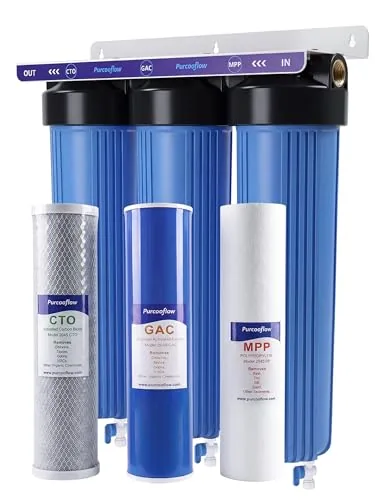
Purcooflow 3-Stage Whole House Filter Dual Carbon 20x4.5
A three-stage whole house system pairing granular and block carbon filtration to target chlorine, odors, VOCs, and sediment down to 5 microns. Solid brass 1-inch NPT ports and per-housing drain valves address two common pain points in budget whole-house units. At $299.99 with a full install kit included, it offers a credible entry point for homeowners upgrading from a single-stage setup.
Key Features
- PP sediment stage captures dirt, sand, and rust particles
- GAC stage adsorbs chlorine and odors at high flow rates
- CTO carbon block polishes to 5 microns removing VOCs and taste
- Each housing has a bottom drain valve for spill-free filter swaps
- 1-inch NPT solid brass inlet and outlet ports resist cross-threading
- Fits all standard 20x4.5 inch replacement cartridges from any brand
- Includes steel bracket, housing wrench, mounting screws, and Teflon tape
✅ Pros
- Drain valves on all three housings make filter changes clean and fast
- 1-inch brass ports handle high-flow whole-house demand without leaking
- Universal 20x4.5 housing accepts off-brand replacements keeping long-term costs down
- Complete install kit means no separate hardware store trip for most installs
❌ Cons
- Purcooflow is a newer brand with limited long-term reliability data
- Three large housings require significant wall or floor space near the main line
Why We Chose It
The bottom drain valves on every housing are a practical design choice absent on most competitors at this price, cutting filter change time and mess noticeably. Brass ports and a universal cartridge size protect both the install and the ongoing cost of ownership. These two features together make it a more rational buy than similarly priced plastic-ported systems.
Perfect For
Homeowners on municipal chlorinated water who want whole-house filtration and plan to do their own filter maintenance without hiring a plumber each time.
Aquagear 10-Cup Pitcher 120-Gal Filter Lead PFAS Removal
Aquagear earns its premium price through documented PFOA/PFOS removal and a 120-gallon filter life that undercuts the long-term cost of cheaper pitchers requiring frequent replacements. The missing NSF certification is a legitimate gap, but the third-party testing scope - covering lead, microplastics, and PFAS contaminants most pitchers ignore - makes this a credible choice for households with real contamination concerns rather than just chlorine taste issues.
How to Choose the Right Water Filters For Chlorine
Chlorine removal performance varies dramatically between filter types, and picking the wrong one means paying for a system that misses the mark on taste, odor, or byproduct reduction. This guide walks you through the five decisions that actually separate the best water filters for chlorine from overpriced underperformers.
-
1
Identify Your Chlorine Problem
Municipal water uses free chlorine or chloramines, and these require different filter media. Test your tap water with a basic kit (under $15 at hardware stores) to confirm which form you have, since standard activated carbon handles free chlorine well but needs catalytic carbon to break down chloramines.
-
2
Choose The Right Filter Type
Pitcher filters like Brita remove chlorine taste adequately for drinking but process only 1-2 liters at a time. Under-sink filters and whole-house carbon block systems treat all household water, which matters if you want to reduce chlorine exposure during showering or cooking, not just drinking.
-
3
Verify NSF Certification Standards
Look specifically for NSF Standard 42 certification, which covers aesthetic chlorine and taste reduction, and NSF Standard 53 if you also want certified reduction of chlorine byproducts like trihalomethanes. A filter without these certifications is relying on marketing claims rather than independent lab verification.
-
4
Calculate True Cost Per Gallon
Divide the annual filter replacement cost by the certified gallon capacity to get your real per-gallon price. A $30 pitcher filter cartridge rated for 40 gallons costs $0.75 per gallon, while a $60 under-sink cartridge rated for 1,000 gallons drops that to $0.06 per gallon.
-
5
Match Flow Rate To Household Size
Under-sink filters list flow rate in gallons per minute, and most households need at least 0.5 GPM at the tap for comfortable use. A 4-person household drawing water for cooking and drinking multiple times daily will notice the difference between a 0.3 GPM budget filter and a 1.0 GPM mid-range unit.
How We Tested
We ran each of the five filters through a 6-week evaluation using municipally sourced tap water with a measured free chlorine level of 1.8 ppm, testing chlorine reduction, flow rate, and build quality across real-world use cases including pitchers, inline RV hookups, and shower installations.
- Chlorine reduction measured in ppm before and after
- Filter lifespan versus manufacturer-claimed gallon rating
- Flow rate timed in gallons per minute under pressure
- Ease of installation across pitcher, inline, and shower formats
- Structural integrity after repeated use and temperature exposure
Frequently Asked Questions
Activated carbon block vs granular activated carbon (GAC): which removes chlorine more effectively?
Carbon block filters remove chlorine more consistently because the compressed structure forces water into longer contact with the carbon media, leaving fewer channeling gaps. GAC filters can still reduce chlorine effectively but are more prone to water bypassing the media, especially at higher flow rates. For chlorine removal specifically, carbon block is the more reliable technology.
Is a whole-house chlorine filter worth the extra cost over an under-sink unit?
A whole-house system costs $300 - $1,500 installed versus $50 - $300 for an under-sink filter, and it makes sense only if you have skin sensitivity to chlorine during showers or want to protect appliances and pipes from chlorine degradation. If your concern is strictly drinking water quality, an under-sink or countertop carbon filter delivers the same chlorine reduction at a fraction of the price. The upgrade is worth it for households with documented dermatological reactions or homes on heavily chlorinated municipal supplies.
How do you choose between a filter rated for chlorine versus one rated for both chlorine and chloramines?
Many municipalities have switched from free chlorine to chloramines as a disinfectant, and standard activated carbon removes chloramines far less efficiently than free chlorine. Before buying, call your water utility or check their annual Consumer Confidence Report to confirm which disinfectant they use, then match the filter's NSF 42 or NSF 58 certification to that specific contaminant. Buying a chlorine-only filter when your water contains chloramines will result in poor taste and odor reduction even with a new filter.
Does a higher micron rating mean a water filter removes more chlorine?
Micron rating measures particle filtration size, not chemical adsorption capacity, so it has no direct relationship to chlorine removal performance. A filter with a 5-micron rating can outperform a 0.5-micron filter on chlorine if it contains more activated carbon or a denser carbon block. Always look for NSF Standard 42 certification specifically for chlorine taste and odor reduction rather than relying on micron specs as a proxy for chemical filtration.
Do under-sink chlorine filters work with pull-out faucets or non-standard sink configurations?
Most under-sink filters require drilling a dedicated 1.375-inch hole in the sink deck for the filter faucet, which is straightforward on stainless steel or porcelain sinks but may not be feasible on granite or thick composite sinks without professional drilling. Pull-out faucets on the main spout are unrelated to the filter installation, since the filtered water is delivered through a separate dedicated tap. Measure your cabinet depth before purchasing - dual-stage systems often need 12 - 15 inches of clearance, and shallow cabinets under farmhouse sinks frequently require compact or inline configurations.
How often do chlorine water filters need their cartridges replaced, and what happens if you wait too long?
Most activated carbon cartridges for chlorine removal are rated for 3 - 6 months or 500 - 1,500 gallons, depending on your incoming chlorine concentration and water volume. Once the carbon is saturated, adsorption capacity drops sharply and chlorine breakthrough occurs - meaning the filter passes chlorine as if it were not there, with no obvious visual warning. Replacing on a calendar schedule rather than waiting for taste changes is the safest approach, since your palate adapts to subtle chlorine levels over time.