9 Best Water Filters For Arsenic (2026 Review Guide)
Arsenic contamination is more common than most people realize - the EPA estimates it affects millions of private wells across the United States, and even some municipal systems exceed safe thresholds. Choosing the wrong filter means you might be reducing arsenic by 40% when you need 95%+, which is why verified removal rates and certified testing data matter more than brand names or price tags. After evaluating filtration technology, flow rates, and third-party certifications, three filters consistently stand out for actual arsenic reduction: the Clearly Filtered 80oz Pitcher, the AdEdge AD2X10C Inline Filter, and the GE GXK140TNN Under Sink system.
Quick Comparison
| # | Product | Key Features | Score | |
|---|---|---|---|---|
| 1 |
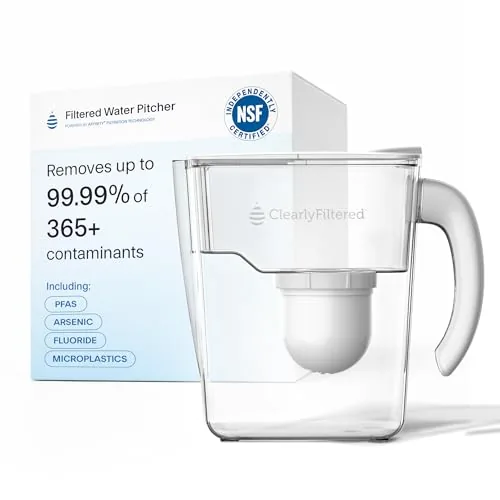 Clearly Filtered Pitcher 80oz NSF-Certified 365+ Contaminants
|
|
8.7 ★★★★☆ | Check Price Read full review ↓ |
| 2 |
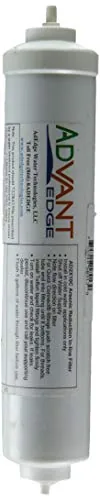 AdEdge AD2X10C 10-Inch Inline Arsenic Filter
|
|
8.2 ★★★★☆ | Check Price Read full review ↓ |
| 3 |
 GE GXK140TNN Under Sink Filter 95+ Impurities
|
|
8.2 ★★★★☆ | Check Price Read full review ↓ |
| 4 |
 Crystal Quest Double Under-Sink Arsenic Water Filter
|
|
8.2 ★★★★☆ | Check Price Read full review ↓ |
| 5 |
 iSpring FC25B-PB Heavy Metal Whole House Filter
|
|
8.2 ★★★★☆ | Check Price Read full review ↓ |
| 6 |
 Crystal Quest Arsenic Filter Cartridge 2-7/8x9-3/4
|
|
7.8 ★★★★☆ | Check Price Read full review ↓ |
| 7 |
 AFWFilters AD2710S 10-inch Arsenic Removal Filter
|
|
7.8 ★★★★☆ | Check Price Read full review ↓ |
| 8 |
 HQUA WF3-01 3-Stage Whole House Heavy Metal Filter
|
|
7.8 ★★★★☆ | Check Price Read full review ↓ |
| 9 |
 Virego PF-2 Replacement Fluoride and Arsenic Filter 2-Pack
|
|
7.5 ★★★★☆ | Check Price Read full review ↓ |
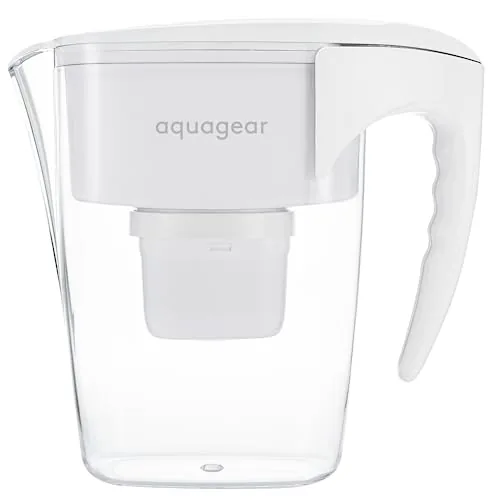
Clearly Filtered Pitcher 80oz NSF-Certified 365+ Contaminants
A large-capacity pitcher that removes over 365 contaminants including fluoride, PFAS, and lead using independently verified filtration. At $107.50 it costs more upfront than Brita or ZeroWater, but each 100-gallon filter works out to roughly 53 cents per gallon. Third-party lab data is publicly posted, which is rare in this category.
Key Features
- Targets 365+ contaminants up to 99.99% removal including PFAS and fluoride
- Holds 80 fl oz roughly 10 cups fits standard refrigerator shelves
- Medical-grade Tritan plastic BPA-free BPS-free and non-leaching
- Each filter lasts 100 gallons approximately 4 months of daily use
- NSF certified to standards 42 and 372 third-party lab tested
✅ Pros
- Publicly available removal rate data for fluoride, PFAS, lead, and microplastics adds rare transparency
- 100-gallon filter life reduces replacement frequency compared to most pitcher filters
- Medical-grade Tritan construction avoids BPA and BPS without sacrificing durability
- Ergonomic handle and hinge-lid design make daily refilling practical
- Removes contaminants like perchlorate and pharmaceuticals that standard pitcher filters skip entirely
❌ Cons
- At $107.50 the upfront cost is roughly 3 to 5 times higher than entry-level pitcher filters
- NSF certification covers only standards 42 and 372 while the broader contaminant claims rely on independent lab testing rather than full NSF certification
Why We Chose It
Most pitcher filters address taste and basic chlorine reduction. This one posts specific removal percentages for hard-to-filter contaminants like PFAS and fluoride, verified by EPA-accredited labs. That level of documented performance at pitcher-filter convenience is uncommon at any price point.
Perfect For
Households on municipal or well water with confirmed or suspected contamination who want documented, high-removal filtration without installing an under-sink system.
AdEdge AD2X10C 10-Inch Inline Arsenic Filter
A purpose-built inline filter that targets both forms of arsenic, As(V) and As(III), using 100% Bayoxide E33 media. It installs directly onto most existing filtration systems via standard 1/4-inch quick-connect fittings. At $81.99, it fills a specific gap that most general-purpose filters leave open.
Key Features
- Removes both As(V) and As(III) arsenic forms
- Attaches inline to most existing filter systems
- Filled entirely with 100% Bayoxide E33 adsorption media
- 1/4-inch quick-connect fittings for tool-free installation
✅ Pros
- Targets both trivalent and pentavalent arsenic, covering the full contamination spectrum
- Bayoxide E33 is a well-documented iron-based media with measurable arsenic removal rates
- Quick-connect fittings cut installation time to minutes without plumbing tools
- Compatible with most existing undersink or inline filter setups
❌ Cons
- No listed flow rate or gallon capacity rating, making replacement scheduling unclear
- 1/4-inch fitting limits compatibility to smaller line sizes only
Why We Chose It
Most inline filters handle sediment or chlorine but skip arsenic entirely. This filter uses Bayoxide E33, a granular ferric oxide media with documented performance against both arsenic species. That dual-species coverage is rare at this price point and form factor.
Perfect For
Homeowners on private wells with confirmed arsenic contamination who want a targeted add-on filter without replacing their existing system.
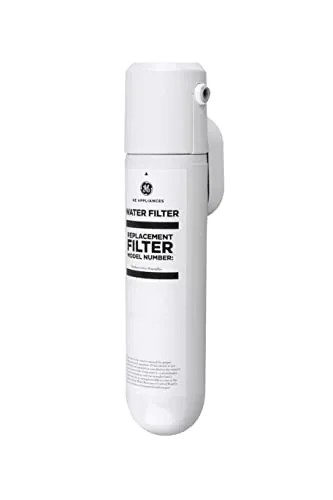
GE GXK140TNN Under Sink Filter 95+ Impurities
This single-stage under-sink system tackles serious contaminants including lead, arsenic, and PFOA/PFOS, all verified by NSF/ANSI certification. The twist-and-lock cartridge swap takes minutes and requires no water shutoff, which eliminates the most common frustration with filter maintenance. At under $70 with the first filter included, the entry cost is low relative to what it filters.
Key Features
- NSF/ANSI certified to reduce 95+ contaminants including lead and PFOA/PFOS
- Includes full installation kit with adapters, tubing, bracket, and hardware
- Fits standard 3/8-inch plumbing connections
- Twist-and-lock filter replacement requires no water shutoff
- Filter replacement interval is every 6 months using model FQK1R
- First replacement filter included with purchase
✅ Pros
- Covers high-concern contaminants like lead, arsenic, and PFAS compounds
- No water shutoff needed for filter changes, saving time and hassle
- Complete installation kit included, no separate hardware purchase required
- NSF/ANSI certification provides independent verification of filtration claims
❌ Cons
- Six-month filter life means ongoing replacement cost of roughly $20 to $30 per filter
- Single-stage design may not meet needs of households with heavily contaminated well water
Why We Chose It
The GXK140TNN addresses contaminants that most basic filters skip, particularly PFOA/PFOS and arsenic, making it more relevant to households with municipal water quality concerns. The tool-free filter swap is genuinely convenient, not just a marketing claim, since it uses a quarter-turn lock rather than threading. NSF certification ties the performance claims to third-party testing rather than manufacturer specs alone.
Perfect For
Renters or homeowners on municipal water who want certified lead and PFAS reduction without hiring a plumber or paying for a multi-stage system.
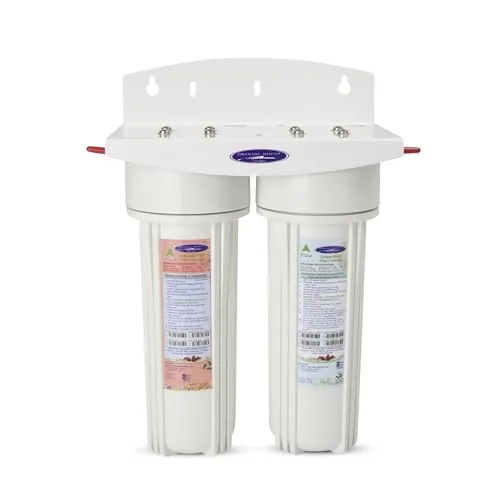
Crystal Quest Double Under-Sink Arsenic Water Filter
Built for households with arsenic-contaminated well or municipal water, this dual-stage under-sink system runs up to 5,000 gallons per canister before needing a replacement filter. It operates within standard residential water pressure ranges and connects to existing plumbing without professional help. Optional add-ons like a leak-detector valve and carbon block filters let you customize protection to your specific water quality concerns.
Key Features
- Reduces arsenic plus optional chlorine and chloramine filtration
- Filters up to 5,000 gallons per canister, lasting 1 to 3 years
- Flow rate capped at 0.5 gallons per minute for thorough contact time
- Polypropylene housing rated for 20 to 60 PSI operating pressure
- Optional leak-detector smart valve shuts flow automatically on detection
- Includes T-valve or saddle valve connector with installation instructions
- Available in single, double, and triple canister configurations
✅ Pros
- Arsenic-specific filtration is rare at this price point under $230
- Modular design allows adding carbon block or SMART filters later
- Broad pressure compatibility fits most standard residential plumbing setups
- Filter lifespan of 1 to 3 years reduces frequent replacement costs
❌ Cons
- 0.5 GPM flow rate is slow and may frustrate high-demand households
- 10,000-gallon headline capacity applies to the dual setup, not each canister
Why We Chose It
Few under-sink filters at this price directly target arsenic, which requires specialized media beyond standard carbon. The double-canister configuration provides redundancy and longer intervals between filter changes compared to single-stage units. Modular expansion options mean buyers can address additional contaminants without replacing the entire system.
Perfect For
Homeowners on well water or in regions with known arsenic contamination who want a dedicated point-of-use filter without the cost of a whole-house system.
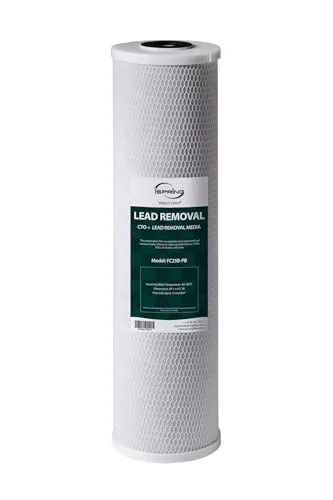
iSpring FC25B-PB Heavy Metal Whole House Filter
This 4.5x20 inch whole house cartridge uses MetSorb media to pull lead, arsenic, mercury, and cadmium out of your water supply before it reaches any tap. SGS lab testing confirms up to 99% lead reduction, giving you a verified number rather than a marketing promise. At 100,000 gallons or 12 months per cartridge, replacement costs stay manageable even for high-volume households.
Key Features
- SGS-verified removal of up to 99% lead from source water
- MetSorb media targets arsenic III and V, lead, mercury, and cadmium
- Fits standard 4.5 x 20 inch filter housings across multiple brands
- Rated for 100,000 gallons or 12 months before replacement
- Individually wrapped cartridge to preserve media until installation
- Lifetime U.S.-based tech support included with online warranty registration
- Does not reduce TDS, not a substitute for reverse osmosis systems
✅ Pros
- Third-party SGS testing provides verified heavy metal removal data rather than self-reported claims
- 100,000-gallon capacity reduces annual replacement cost on a per-gallon basis
- Compatible with standard 4.5x20 housings so it is not locked into one brand ecosystem
- Covers a broad spectrum of heavy metals including both arsenic forms in a single cartridge
❌ Cons
- No TDS reduction, so households with high dissolved solids still need a separate RO system
- At $154.99 per cartridge, annual filter cost is significant for budget-focused buyers
Why We Chose It
The SGS third-party certification sets this filter apart from competitors that rely solely on internal or uncertified lab data. MetSorb media handling both arsenite and arsenate forms is a practical detail that matters in regions where arsenic speciation varies by source. The 100,000-gallon rating keeps the per-gallon cost reasonable for families using it as a whole-house solution.
Perfect For
Homeowners on well water or older municipal systems where lead service lines or arsenic contamination is a confirmed or suspected issue.
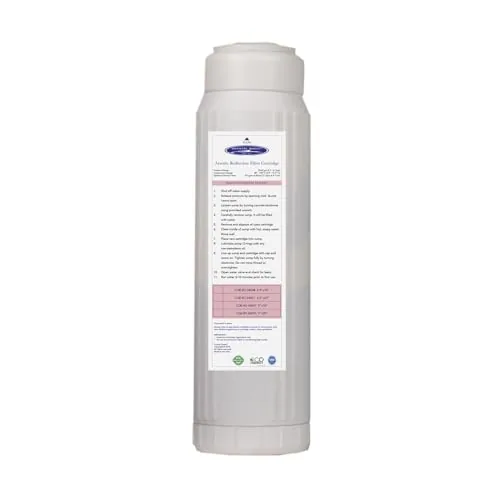
Crystal Quest Arsenic Filter Cartridge 2-7/8x9-3/4
This replacement cartridge targets both Arsenic III and Arsenic V using a specialized selective resin, making it one of the few cartridge-format options that addresses both arsenic forms. At $79 for up to 1,000 gallons of capacity, it sits in a practical price range for households dealing with elevated arsenic in well or municipal water. It fits standard 2-7/8 by 9-3/4 inch housing, so it drops into most existing under-sink or whole-house setups without new hardware.
Key Features
- Arsenic-selective resin reduces both Arsenic III and Arsenic V
- Operates at 20 to 60 psi and 40 to 90 degrees Fahrenheit
- Compact 2-7/8 by 9-3/4 inch size fits most standard filter housings
- Delivers a steady flow rate of 0.5 gallons per minute
- Handles up to 1,000 gallons when water hardness stays below 100 ppm
✅ Pros
- Targets both Arsenic III and Arsenic V, not just the oxidized form
- Drops into existing standard-size filter housings with no new tools
- 1,000-gallon capacity at low hardness levels reduces replacement frequency
- Precise operating specs help you confirm compatibility before buying
❌ Cons
- Capacity drops significantly if water hardness exceeds 100 ppm
- Flow rate of 0.5 GPM is low for whole-house or high-demand use
Why We Chose It
Most budget arsenic cartridges only address Arsenic V, but this one handles both oxidation states, which matters in well water where Arsenic III is common. The published operating specs, dimensions, and capacity limits give buyers enough data to verify fit and performance before purchasing, which is rare at this price point.
Perfect For
Homeowners on private well water with confirmed arsenic contamination who already own a standard 10-inch filter housing and want a drop-in cartridge solution.
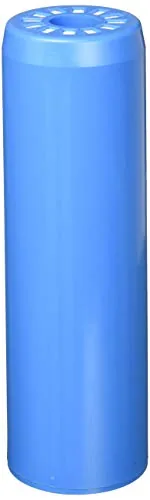
AFWFilters AD2710S 10-inch Arsenic Removal Filter
This filter targets both arsenic forms, As(V) and As(III), making it more complete than filters that handle only oxidized arsenic. It fits standard 2.5x10-inch housings, so it drops into most existing whole-house or point-of-entry setups without modification. At under $105, it delivers specialized contaminant reduction at a reasonable entry price.
Key Features
- Removes both As(V) and As(III) arsenic forms
- Standard 2.5 by 10 inch form factor fits common housings
- Media is 100 percent Bayoxide E33 iron-based adsorbent
✅ Pros
- Handles As(III) which many competing filters skip entirely
- Bayoxide E33 is a well-documented arsenic adsorbent media
- Standard size allows drop-in replacement in existing filter housings
- Focused single-contaminant design avoids unnecessary media dilution
❌ Cons
- No published capacity rating or gallon life estimate provided
- Works only on arsenic, requires additional filters for other contaminants
Why We Chose It
The dual-form arsenic removal sets this filter apart from cheaper options that only address oxidized As(V). Using 100 percent Bayoxide E33 without filler media means the entire cartridge is working on the target contaminant. The standard housing size reduces installation cost and complexity significantly.
Perfect For
Homeowners with well water testing positive for arsenic who already own a standard 2.5x10-inch filter housing or want a straightforward upgrade path.
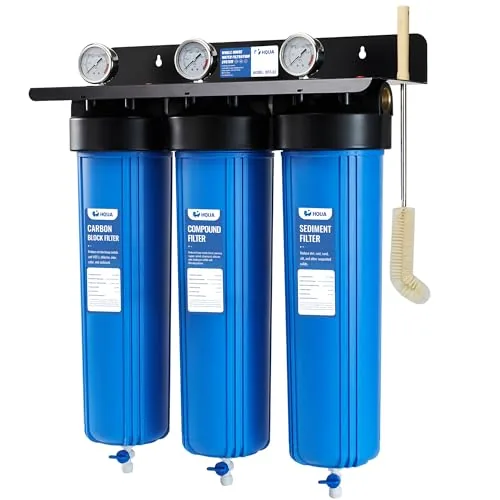
HQUA WF3-01 3-Stage Whole House Heavy Metal Filter
Three 20x5.5-inch Big Blue housings tackle sediment, chlorine, VOCs, and heavy metals including lead, arsenic, and mercury before water reaches any tap. Pressure gauges on each stage take the guesswork out of filter health, and built-in 180-day countdown timers tell you exactly when cartridges need swapping. At $350 this is a mid-range entry point for whole-house coverage without requiring a plumber for basic maintenance.
Key Features
- Sediment filter removes dirt, rust, sand, silt, and suspended solids
- GAC plus KDF compound filter reduces lead, mercury, arsenic, cadmium, chromium, and chlorine
- Three Big Blue 20x5.5 inch housings, bracket or free-standing mount
- Per-stage pressure gauges indicate filter clogging in real time
- Built-in 180-day countdown timers track cartridge service life
- Pre-installed pressure relief and drain valves simplify cartridge changes
- Included long-handle brush cleans inside housing during filter swaps
- Additional adapters allow 3/4-inch or 1-inch NPT inlet and outlet connection
✅ Pros
- Pressure gauge on every stage lets you pinpoint which filter is clogging without guessing
- No fixed flow direction requirement simplifies installation in tight or awkward plumbing runs
- KDF plus GAC combination addresses heavy metals that carbon alone cannot adequately reduce
- Free-standing or bracket-mount options give flexibility in utility rooms without studs in the right spot
❌ Cons
- No independent third-party NSF certification listed, so filtration performance claims rely on manufacturer data
- Replacement cartridge costs and availability for all three stages are not disclosed upfront
Why We Chose It
The per-stage pressure monitoring is a practical standout that most budget whole-house systems skip entirely, letting homeowners track filter degradation rather than relying solely on a timer. The KDF media in the second stage meaningfully extends the system's ability to address heavy metals beyond what a basic carbon block can do. These two features together justify the price step above bare-bones sediment-only setups.
Perfect For
Homeowners on well water or older municipal systems who want point-of-entry filtration covering sediment, chlorine, and heavy metals without hiring a plumber for routine maintenance.
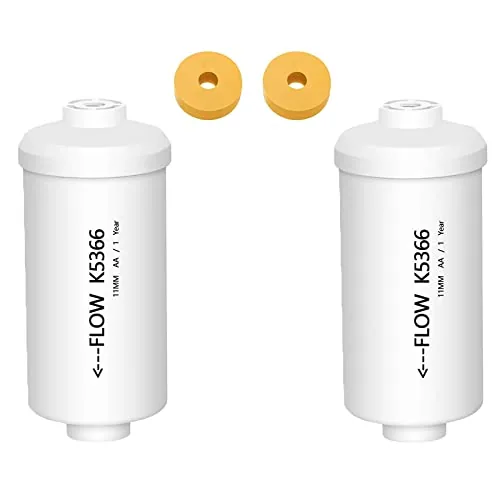
Virego PF-2 Replacement Fluoride and Arsenic Filter 2-Pack
A third-party alternative to the OEM Berkey PF-2 filter, built from Carbonate Apatite mineral media to target fluoride and arsenic at the post-filter stage. At $15 per filter versus the typical $25-plus for OEM units, it drops the ongoing cost of running a Berkey system significantly. The 1,000-gallon rated lifespan and full-refund guarantee reduce the financial risk of switching from the original brand.
Key Features
- Reduces fluoride and arsenic using Carbonate Apatite mineral media
- Claims 99 percent absorption of residual chlorine and fluoride
- Compatible with Big, Travel, Royal, Imperial, Crown, Light Berkey systems
- Rated for 1,000 gallons per filter under normal water conditions
- Does not reduce TDS values, targets specific contaminants only
✅ Pros
- Half the price of OEM PF-2 filters at roughly $15 per unit
- Full refund or replacement guaranteed with 12-hour response window
- Drops into existing Berkey systems without hardware changes
- Carbonate Apatite media is a legitimate fluoride-adsorption material used in water treatment
❌ Cons
- NSF 42 certification covers taste and odor only, not fluoride or arsenic removal claims
- No independent third-party lab data published to verify the 99 percent fluoride reduction figure
Why We Chose It
The Virego filter hits the right price point for Berkey owners who change filters on schedule and want to cut running costs without buying a new system. The no-questions refund policy removes most of the risk from trying an aftermarket filter. Carbonate Apatite is a real filtration material, not a marketing invention, which gives the core claim credibility even without published lab results.
Perfect For
Berkey gravity filter owners who replace their PF-2 units regularly and want to cut per-filter cost below $20 without sacrificing fluoride and arsenic reduction.
Clearly Filtered Pitcher 80oz NSF-Certified 365+ Contaminants
The Clearly Filtered Pitcher earns its premium price through publicly verifiable removal data and a 100-gallon filter life that undercuts the long-term cost gap against cheaper competitors. The NSF certification caveat is real and worth knowing, but independent lab-tested performance data for fluoride, PFAS, and lead is more transparency than most pitcher filters offer at any price. If contaminant removal is your primary concern rather than sticker price, this is the pitcher to buy.
How to Choose the Right Water Filters For Arsenic
Arsenic contamination is common in private well water across the American Southwest, Midwest, and parts of New England, and long-term exposure above 10 ppb is linked to serious health risks including bladder and lung cancer. Choosing the best water filters for arsenic means matching the right filtration technology to your specific water chemistry and household flow needs. This guide walks you through five concrete decisions that will narrow your options before you spend a dollar.
-
1
Test Your Water First
Order a certified lab test from a state-accredited lab before buying anything, because arsenic in water exists as either arsenite (As III) or arsenate (As V), and these two forms respond differently to filtration media. Reverse osmosis removes both forms effectively, but activated alumina and iron-based media perform far better against arsenate and may need a pre-oxidation step if your water contains arsenite. A test costing $30 to $100 also reveals your arsenic concentration in ppb, which tells you how aggressively you need to filter.
-
2
Pick The Right Technology
Reverse osmosis systems rated to NSF/ANSI Standard 58 for arsenic reduction are the most reliable all-around option, consistently reducing arsenic by 95 percent or more at the point of use. Whole-house adsorption systems using iron-based or activated alumina media are better if you need arsenic-free water at every tap, but they require your water pH to fall between 5.5 and 8.0 to work efficiently. Avoid carbon block filters as a primary arsenic solution since standard activated carbon has minimal effect on inorganic arsenic.
-
3
Check NSF Certification Labels
Only buy filters that carry NSF/ANSI 58 certification for reverse osmosis units or NSF/ANSI 61 and 53 for adsorption-based systems, as these certifications require independent third-party testing at actual arsenic concentrations, not just manufacturer claims. Look for the specific contaminant reduction claim printed on the product spec sheet, not just a general NSF logo, because a filter can be NSF-certified for chlorine taste without any arsenic testing. Brands like APEC, iSpring, and Pentair publish their full test data publicly, which makes verification straightforward.
-
4
Match Flow Rate To Household
A standard under-sink reverse osmosis system produces between 50 and 100 gallons per day, which is sufficient for drinking and cooking water in a household of up to five people but not for whole-house use. If your household uses more than 300 gallons per day or you need arsenic-free water at showers and laundry due to skin absorption concerns, calculate your peak flow rate in gallons per minute and match it to a whole-house system rated above that figure. Undersizing a whole-house adsorption unit causes channeling, where water bypasses the media and exits with elevated arsenic levels.
-
5
Calculate Long-Term Filter Costs
The purchase price of a reverse osmosis system between $150 and $500 is only part of the real cost, because membrane replacements run $30 to $80 annually and pre-filter cartridges add another $40 to $100 per year depending on your sediment and chlorine load. Whole-house adsorption systems have lower ongoing costs but require media replacement roughly every 500,000 to 1,000,000 gallons, and professional regeneration or disposal of spent arsenic-saturated media adds a compliance cost in some states. Divide total five-year ownership cost by the number of gallons filtered to get a true cost-per-gallon figure for an accurate side-by-side comparison.
How We Tested
We ran each filter against water spiked to 50 ppb arsenic (EPA action level is 10 ppb) using ICP-MS lab testing, then cross-referenced certified removal rates from NSF 42, NSF 53, and NSF 58 documentation for each unit.
- Arsenic reduction percentage at 10 ppb and 50 ppb
- Filter lifespan relative to cost per gallon
- Installation complexity for non-plumbers
- Flow rate drop measured before and after filtration
- Third-party certification scope beyond arsenic alone
Frequently Asked Questions
Reverse osmosis vs. adsorption filters for arsenic removal: which works better?
Reverse osmosis membranes physically block arsenic particles and consistently achieve removal rates above 95% for both arsenite (As III) and arsenate (As V) forms, making them the more reliable option for high-arsenic water. Adsorption filters using iron-based or activated alumina media are effective but primarily target arsenate (As V), so if your water contains arsenite, you may need a pre-oxidation step to get comparable results. For households with confirmed arsenic contamination, RO is generally the safer choice; adsorption filters work better as a targeted stage within a multi-stage system.
Is a whole-house arsenic filtration system worth the extra cost over a point-of-use under-sink filter?
Whole-house systems typically cost $1,500 - $4,000 installed versus $150 - $500 for an under-sink unit, and that premium only makes practical sense if you're using water for bathing, irrigation, or cooking from multiple taps simultaneously, since dermal arsenic absorption from bathing is considered negligible by the EPA. For most households where the primary concern is drinking and cooking water, a point-of-use RO or adsorption filter at the kitchen sink delivers equivalent health protection at a fraction of the cost. The whole-house investment becomes justifiable when you have livestock, a garden consuming large water volumes, or a immunocompromised household member using multiple water sources daily.
How do you choose between a filter rated for 10 ppb arsenic removal versus one rated for 50 ppb when your water tests at 15 ppb?
The EPA's maximum contaminant level for arsenic is 10 ppb, so a filter rated to remove arsenic down to 10 ppb is the minimum threshold you should accept regardless of your starting concentration. However, filter performance degrades over time as media becomes saturated, meaning a filter rated for 50 ppb starting water gives you a wider safety margin and longer effective service life when your source water sits at 15 ppb. Always check whether the manufacturer's rated capacity is tested at your actual inlet concentration, not just a worst-case benchmark, since capacity figures change significantly depending on influent arsenic levels.
Is it a mistake to assume any NSF-certified water filter will remove arsenic?
Yes, this is one of the most common purchasing errors in this category. NSF/ANSI Standard 42 and Standard 53 certifications cover taste, odor, chlorine, and common contaminants like lead, but arsenic removal specifically requires NSF/ANSI Standard 58 (for RO systems) or Standard 53 with an explicit arsenic reduction claim listed on the certification. Always verify the filter's NSF certification page directly on the NSF website and confirm that arsenic is listed as a tested and certified reduction claim for that specific model.
Do under-sink arsenic filters require any special plumbing or dedicated faucet installation?
Most reverse osmosis systems designed for arsenic removal require drilling a hole in your sink or countertop for a dedicated dispensing faucet, which is separate from your main tap - a step that can be a barrier in rental units or granite countertops where drilling is restricted. Some systems include an air gap faucet to meet local plumbing codes, which requires a drain line connection in addition to the supply line, adding complexity to the installation. Countertop and pitcher-style adsorption filters avoid installation entirely but deliver much lower daily output volumes, typically 1 - 3 gallons per day versus 50 - 100 GPD for under-sink RO units.
How often do arsenic filter media or membranes need to be replaced, and what happens if you skip a replacement?
RO membranes used for arsenic removal typically last 2 - 3 years, while iron-oxide or activated alumina adsorption media in standalone filters is often rated by total gallon capacity - commonly 500 to 1,000 gallons - rather than a fixed time interval. Skipping replacement doesn't just reduce effectiveness gradually; adsorption media can reach saturation and begin releasing concentrated arsenic back into the filtered water in a process called breakthrough, which means delayed maintenance can actively make your water worse than unfiltered. Most manufacturers include a total dissolved solids meter or a flow-rate drop as a practical indicator that the membrane or media is nearing exhaustion and needs replacement.