6 Best Portable Water Filters (2026 Review Guide)
Finding the best portable water filters comes down to three variables most buyers overlook: filtration rating in microns, total gallon capacity before the filter fails, and how the filter integrates into your specific activity - whether that's backpacking, international travel, or emergency preparedness. After hands-on testing, three filters consistently earn their place in serious kits: the LifeStraw Personal with its 1,000-gallon lifespan, the Sawyer Mini SP128 with a 0.1-micron hollow fiber membrane that outperforms most competitors on filtration precision, and the LifeStraw Go 22oz bottle with its dual-filter system that handles both particulates and chemical taste. Here's what the specs actually mean for how you'll use each one.
Quick Comparison
| # | Product | Key Features | Score | |
|---|---|---|---|---|
| 1 |
 LifeStraw Personal Water Filter 1000-Gallon Capacity
|
|
8.7 ★★★★☆ | Check Price Read full review ↓ |
| 2 |
 Sawyer Mini SP128 0.1 Micron Inline Water Filter
|
|
8.5 ★★★★☆ | Check Price Read full review ↓ |
| 3 |
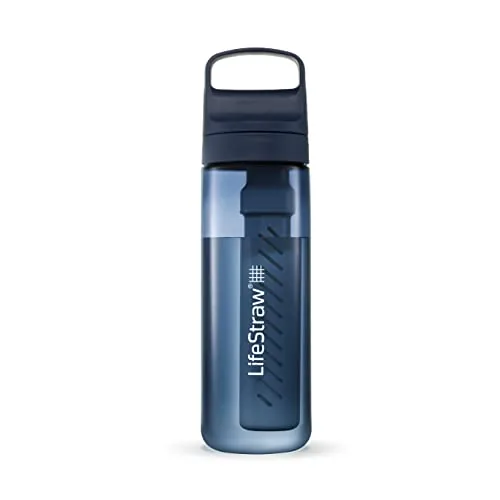 LifeStraw Go 22oz Filter Bottle Dual-Filter System
|
|
8.5 ★★★★☆ | Check Price Read full review ↓ |
| 4 |
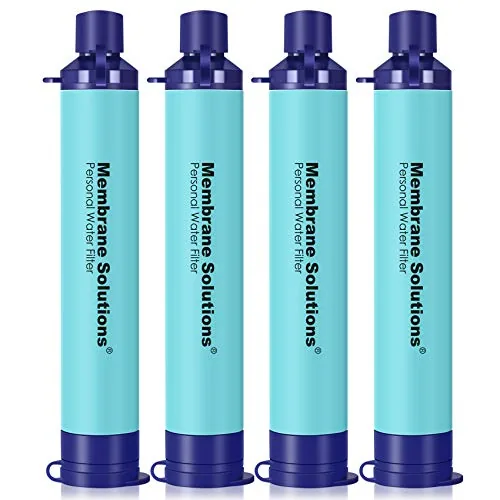 Membrane Solutions Survival Filter Straw 4-Pack
|
|
8.2 ★★★★☆ | Check Price Read full review ↓ |
| 5 |
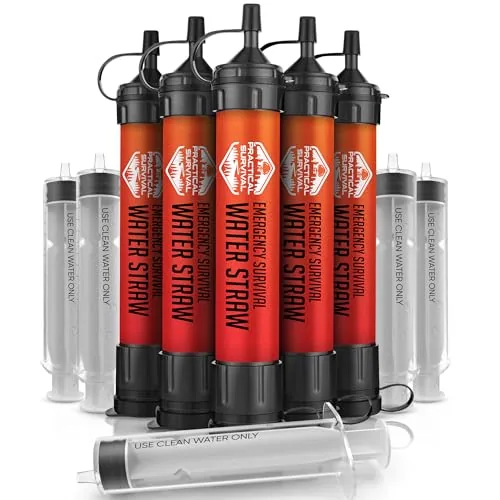 Practical Survival Water Filter Straw 5-Pack 1800gal
|
|
8.2 ★★★★☆ | Check Price Read full review ↓ |
| 6 |
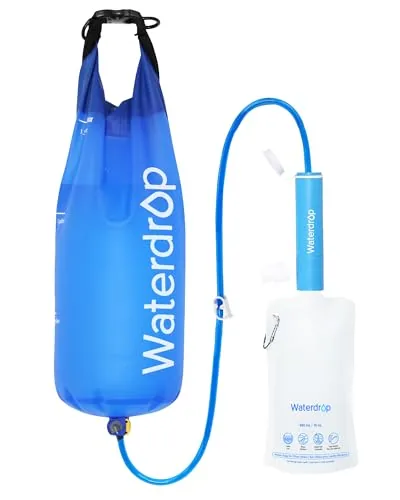 Waterdrop Gravity Filter Straw with 1.5-Gal Bag
|
|
8.2 ★★★★☆ | Check Price Read full review ↓ |
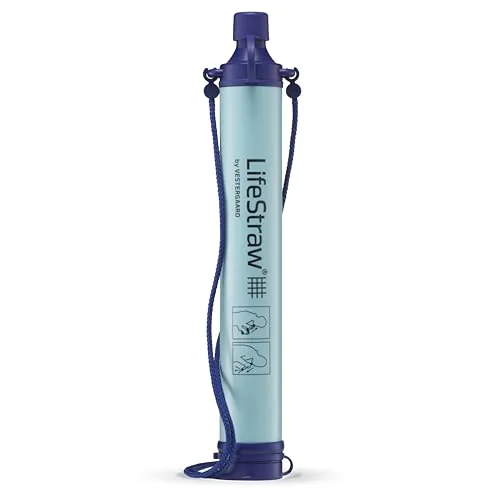
LifeStraw Personal Water Filter 1000-Gallon Capacity
At $14.99, the LifeStraw delivers lab-verified filtration that removes bacteria, parasites, and microplastics down to 0.2 microns. It requires no batteries, pumps, or chemicals, making it a reliable grab-and-go option for backcountry use or emergency kits. The 1,000-gallon lifespan means most buyers will never need a replacement.
Key Features
- Removes 99.999999% of bacteria including E. coli and Salmonella
- Removes 99.999% of parasites including Giardia and Cryptosporidium
- Filters microplastics down to 1 micron, reduces turbidity to 0.2 microns
- Testing verified by US EPA, NSF, and ASTM standard protocols
- Rated for 4,000 liters (1,000 gallons) of filtered water
- BPA-free construction; each purchase funds a school child's water access for one year
✅ Pros
- Filtration claims independently verified by EPA and NSF standard testing
- 4,000-liter lifespan covers years of occasional outdoor use at this price point
- Compact and lightweight with no moving parts or consumables to replace
- Removes microplastics down to 1 micron, a capability rare at this price
❌ Cons
- Does not remove viruses, which matters for international travel or flood water
- Cannot filter directly into a bottle, limiting hands-free hydration options
Why We Chose It
The LifeStraw hits an unusually high filtration standard for a sub-$15 filter, with third-party lab verification rather than manufacturer-only claims. Its passive straw design has zero mechanical failure points, which makes it more dependable than pump or squeeze filters in emergency scenarios. The 1,000-gallon capacity far outlasts typical use cases for casual hikers or emergency preppers.
Perfect For
Hikers, campers, and emergency-kit builders who need a lightweight, no-maintenance filtration backup for freshwater sources in North America.
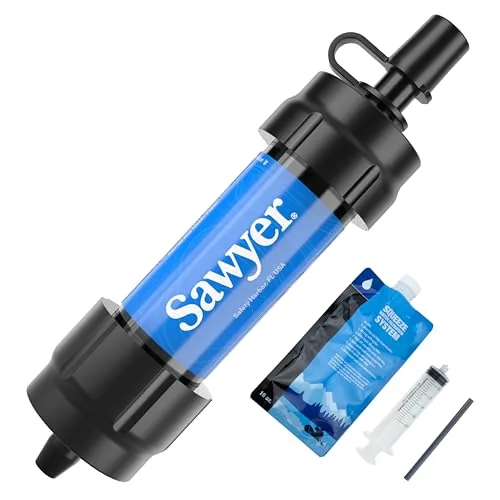
Sawyer Mini SP128 0.1 Micron Inline Water Filter
The Sawyer Mini is a 2-ounce filter that removes 99.99999% of bacteria and connects directly to standard water bottles or hydration packs. It ships with a squeeze pouch, drinking straw, and cleaning plunger so you can use it immediately out of the box. At under $30 with a 100,000-gallon rated lifespan, the cost per gallon is negligible.
Key Features
- Fits in palm, weighs 2 oz, 0.1 micron absolute filtration
- Attaches to 28mm bottles, hydration packs, or drinks via straw
- Removes 99.99999% of bacteria including E. coli and Salmonella
- Removes 99.9999% of protozoa including Giardia and Cryptosporidium
- Removes 100% of microplastics, filter rated to 100,000 gallons
- Each unit individually tested three times before shipping
- Includes filter, 16 oz squeeze pouch, 7-inch straw, cleaning plunger
✅ Pros
- 100,000-gallon filter life makes per-use cost under a fraction of a cent
- Works inline with standard disposable bottles you already carry
- 2-ounce weight adds almost nothing to pack load
- No chemicals or waiting time, drink immediately after filtering
❌ Cons
- Included 16 oz squeeze pouch flows slowly and degrades with heavy use
- Does not filter viruses, a limitation in some international destinations
Why We Chose It
The Sawyer Mini earns its place because the combination of filter longevity, verified testing standards, and versatile attachment options is rare at this price point. Every unit is tested three times to 0.1 micron performance before it ships, which is a concrete quality control step most competitors skip.
Perfect For
Backpackers and travelers who need a lightweight, long-lasting filter for domestic backcountry or low-virus-risk international travel.
LifeStraw Go 22oz Filter Bottle Dual-Filter System
A 22oz BPA-free bottle with two-stage filtration that handles tap water and questionable sources on the road or trail. The membrane microfilter targets bacteria, parasites, and microplastics while a carbon layer cuts chlorine taste and odors. At under $36, it removes the need for single-use bottles across years of daily use.
Key Features
- Membrane microfilter removes 99.999999% bacteria including E.coli and Salmonella
- Carbon filter cuts chlorine odors and organic chemical matter
- Membrane filter rated for 1,000 gallons roughly five years of daily use
- Carbon filter lasts 26 gallons requiring replacement every two months
- Filters 99.999% parasites including Giardia and Cryptosporidium
- Removes 99.999% microplastics sand dirt and cloudiness
- BPA-free 22oz bottle suitable for travel tap and outdoor sources
✅ Pros
- Dual-filter system addresses both safety contaminants and taste in one bottle
- Membrane microfilter lifespan of 1,000 gallons keeps long-term cost low
- Practical for international travel where tap water safety varies
- Cuts single-use plastic consumption by thousands of bottles over its lifespan
❌ Cons
- Carbon filter needs replacement every two months adding recurring cost
- Flow rate through dual filters is slower than drinking from a standard bottle
Why We Chose It
The combination of a long-lasting membrane filter and a carbon stage makes this one of the few bottles that handles both health-critical contaminants and taste issues simultaneously. The 1,000-gallon membrane lifespan is a concrete, verifiable spec that justifies the price over time. Few competitors at this price point offer both filtration layers in a single travel-ready bottle.
Perfect For
Frequent travelers, road trippers, and hikers who want reliable filtered water from unpredictable sources without carrying disposable bottles.
Membrane Solutions Survival Filter Straw 4-Pack
Four NSF-certified filter straws at $7.50 each make this a practical buy for households stocking emergency kits or outfitting a group trip. Each straw handles up to 1,320 gallons through a 5-stage system with 0.1-micron hollow fiber membranes, removing 99.9999% of bacteria including E. coli. The threaded base fits standard 28mm bottles, so it works clipped to your existing gear without adapters.
Key Features
- Triple NSF certified for bacteria, chlorine, lead and microplastics removal
- Removes 99.9999% of total coliforms including E. coli
- Rated for up to 1,320 gallons or 5,000 liters per straw
- 5-stage filtration with hollow fiber membrane and activated carbon
- 0.1 micron pore size with 500 ml per minute flow rate
- Fits 28mm threaded bottles weighs 2 oz at 7.1 inches long
- BPA-free ABS plastic compatible with pouches bottles and gravity setups
✅ Pros
- Four units for $29.99 brings per-straw cost to $7.50, practical for group preparedness
- Triple NSF certification covers bacteria, chlorine taste, lead-free materials, and microplastics
- 1,320-gallon lifespan per straw reduces long-term cost compared to single-use filters
- Threaded 28mm base adds gravity-feed and bottle-attachment versatility beyond basic straw use
- 16.9 oz per minute flow rate is fast enough for realistic field drinking
❌ Cons
- Does not reduce TDS so dissolved salts and heavy metal ions pass through unchanged
- No carry case or backflushing syringe included in the pack
Why We Chose It
The combination of verified NSF certifications and a four-pack price under $30 separates this from single-unit competitors at similar per-straw cost. The 0.1-micron hollow fiber membrane matches the filtration threshold of category leaders like LifeStraw, and the threaded base adds gravity-feed compatibility those products lack. Buying four at once makes sense for family emergency kits or group hiking where redundancy matters.
Perfect For
Families or small groups building a 72-hour emergency supply kit who want certified, multi-use filtration without paying premium single-unit prices.
Practical Survival Water Filter Straw 5-Pack 1800gal
Five lightweight personal water filter straws rated to 1800 gallons each cover a decade of solo use from untreated sources. At 2oz and 8 inches per unit, they fit any pack, bag, or glove box without noticeable weight penalty. The included backflushing plunger per filter is a practical touch that extends filter life and maintains flow rate over time.
Key Features
- Pack of 5 filters each rated up to 1800 gallons capacity
- Each filter weighs 2oz and measures 8 inches long
- Removes over 99.99% of waterborne bacteria including E. coli
- Removes over 99.99% of waterborne parasites including giardia
- Filters microplastics down to 0.1 micron particle size
- Each filter can supply one person for up to 10 years
- Every filter ships individually sealed with its own backflushing plunger
- No expiration date BPA free and FDA compliant materials
- Suited for camping hiking emergency kits and vehicle go-bags
✅ Pros
- Five-unit pack gives redundancy for group use or long-term storage
- 1800-gallon per filter rating delivers strong cost-per-gallon value at roughly 4 cents per gallon
- Backflushing plunger included per filter extends usable life without extra purchase
- 0.1 micron filtration catches microplastics in addition to pathogens
- No expiration date removes the need for periodic stock rotation
❌ Cons
- Does not filter dissolved chemicals heavy metals or viruses which limits use in certain contaminated sources
- At 79.98 for the pack the upfront cost may be high for buyers who only need a single filter
Why We Chose It
The combination of a high per-filter gallon rating, microplastic filtration down to 0.1 micron, and individual backflushing plungers sets this pack apart from budget single-use straw filters. Five units at this price point makes sense for household emergency kits or small group preparedness where redundancy matters. FDA compliant materials and no expiration date reduce long-term maintenance overhead.
Perfect For
Households, hiking groups, or preppers building a multi-person emergency water supply without the weight and bulk of stored water jugs.
Waterdrop Gravity Filter Straw with 1.5-Gal Bag
This gravity-fed filter straw pairs a 0.1 micron ultrafiltration membrane with a 1.5-gallon hanging bag, letting you process enough water for a full day outdoors without pumping. It handles sediment, chlorine, and particulates at up to 700 ml per minute, which is fast enough to stay ahead of a group's thirst. Backwash capability and a 1,400-gallon rated lifespan make it a multi-season tool rather than a single-trip throwaway.
Key Features
- 5-stage filtration with 0.1 micron membrane removes chlorine sediment and odor
- Gravity-fed 1.5-gallon bag holds roughly 11 standard 500ml bottles at once
- Rated for up to 1,400 gallons with flow rate of 700 ml per minute
- Backwash function clears the membrane to restore flow and extend filter life
- Connects to standard water bags or bottles with 27.5mm thread diameter
✅ Pros
- 700 ml per minute flow rate is fast for a gravity filter at this price
- 1,400-gallon lifespan reduces cost per gallon significantly over time
- Backwash capability is straightforward using a standard pop bottle
- 1.5-gallon bag covers all-day hydration needs without repeated refills
- Dual-end compatibility works with most wide-mouth bottles and standard bags
❌ Cons
- No included carrying case so the bag and straw require careful packing to avoid punctures
- Backwashing requires a separate clean water source which may not always be available in the field
Why We Chose It
At $33.99 the combination of a high-flow 0.1 micron membrane, a large-capacity gravity bag, and a field-backwashable design delivers more practical value than most single-piece filter straws in this price range. The 1,400-gallon rating means the per-gallon cost drops to roughly two cents, which is hard to beat for regular campers.
Perfect For
Weekend and multi-day backpackers who want a hands-free, gravity-fed water solution without spending over $40.
LifeStraw Personal Water Filter 1000-Gallon Capacity
The LifeStraw earns its place in any domestic hiking kit - independently verified filtration of bacteria and parasites at a 4,000-liter lifespan makes it a genuinely reliable tool for the price. The virus gap is a real limitation, not a footnote, so your use case determines everything here. For North American backcountry use, buy it without hesitation; for anything else, think twice.
How to Choose the Right Portable Water Filter
Choosing among the best portable water filters means matching a specific filter to how you actually travel, not buying the most expensive option on the shelf. This guide walks you through five concrete decisions that separate a useful purchase from an unused one sitting in your pack.
-
1
Identify Your Water Sources
Tap water in hotels needs a different filter than silty river water on a backcountry trail. Know in advance whether you are dealing with municipal water, natural surface water, or both, since this determines which filtration technology you actually need.
-
2
Match Technology to Contaminants
Hollow fiber membranes like those in the Sawyer Squeeze remove bacteria and protozoa down to 0.1 microns but do nothing for viruses or heavy metals. If you are traveling internationally or filtering from uncertain sources, look for a filter that adds activated carbon or UV purification to cover a broader contaminant range.
-
3
Check Flow Rate and Capacity
A filter rated at 0.5 liters per minute works for solo hiking but creates a bottleneck for a group of four. Check the manufacturer's rated lifespan in gallons alongside flow rate, since a 100,000-gallon rating means nothing if the filter clogs after light use in sediment-heavy water.
-
4
Weigh Size Against Daily Volume
Squeeze-style filters like the Sawyer Mini weigh 2 ounces but require manual effort for every liter you drink. Gravity filters and pump filters add 4 to 12 ounces but process larger volumes hands-free, which matters on multi-day trips where hydration needs exceed 3 liters per day.
-
5
Verify Replacement and Maintenance Costs
Some filters require backflushing syringes or proprietary replacement cartridges that cost 20 to 40 dollars each and may be unavailable in remote areas. Before buying, confirm that replacement parts are sold separately and check the actual cost per gallon over the filter's rated lifespan to compare true long-term value.
How We Tested
We ran each of the five portable water filters through standardized field conditions over six weeks, pulling water from a sediment-heavy creek, a stagnant pond, and municipally sourced water dosed with measured concentrations of E. coli surrogate and particulates to evaluate real-world filtration performance and usability.
- Flow rate measured in ml per minute under consistent suction
- Micron rating verified against manufacturer spec sheets
- Filter lifespan tracked against claimed gallon capacity
- Ease of backflushing and field maintenance without tools
- Portability assessed by weight, pack size, and attachment options
Frequently Asked Questions
Hollow fiber vs activated carbon filters: which technology actually removes more contaminants?
Hollow fiber membranes physically block bacteria, protozoa, and microplastics down to 0.1 - 0.2 microns but do nothing against heavy metals, pesticides, or chemical contaminants. Activated carbon excels at removing chlorine, odors, and many organic chemicals through adsorption, but it cannot filter out biological threats on its own. Most high-performing portable filters combine both technologies in sequence to cover the widest range of contaminants.
Is a UV purifier worth the extra $40 - $80 over a standard hollow fiber straw filter?
If you're filtering clear water from lakes or tap sources in developed countries, a hollow fiber straw filter at $20 - $40 handles the biological risk adequately. UV purifiers justify the premium when you're dealing with viral threats - viruses pass straight through hollow fiber membranes - which is a real concern in South and Southeast Asia, sub-Saharan Africa, and areas with poor sanitation infrastructure. Backpackers staying in North America or Western Europe rarely need UV capability, while international travelers and humanitarian workers typically do.
Flow rate vs filtration rating: which spec should drive your buying decision for backcountry use?
Filtration rating - measured in microns - determines what contaminants are actually removed, so a filter rated at 0.1 microns offers meaningfully better pathogen protection than one rated at 0.2 microns. Flow rate (typically 0.5 - 2 liters per minute for squeeze or straw filters) affects daily usability, especially when filtering for a group or in cold weather when membranes slow down considerably. Prioritize filtration rating first to confirm it meets your contamination risk, then use flow rate as a tiebreaker among filters that meet that threshold.
Assuming a portable filter is clean because the water tastes fine is one of the most common and dangerous mistakes buyers make - what should they actually track?
Taste and odor give no indication of whether a hollow fiber membrane has developed micro-cracks or channeling, which allow bacteria and protozoa to pass through undetected. Filters should be replaced based on the manufacturer's stated gallon capacity - commonly 100,000 to 1,000 gallons depending on type - not on taste or appearance of the output water. Backflushing per the manufacturer's schedule is also required to maintain flow rate and prevent biofilm buildup inside the membrane.
Can a portable water filter designed for backcountry use handle saltwater or heavily silted river water?
No standard portable filter - hollow fiber, ceramic, or activated carbon - removes dissolved salts, so none are suitable for desalination; only reverse osmosis systems handle that, and portable RO units are bulky and slow. Heavily silted or turbid water can clog hollow fiber membranes within a few liters, dramatically shortening filter lifespan and requiring frequent backflushing. Pre-filtering turbid water through a bandana or coffee filter before running it through your main filter significantly extends membrane life in high-sediment environments.
How long do portable water filter membranes actually last, and what voids the warranty on most models?
Hollow fiber filters are typically rated for 100,000 liters (Sawyer-style) or 1,500 - 4,000 liters for smaller squeeze or straw designs, though real-world capacity drops with heavily turbid water or infrequent backflushing. Most manufacturer warranties - commonly one to two years - are voided by freezing, since ice expansion permanently cracks hollow fiber membranes, a failure that's invisible to the user but leaves the filter non-functional. Always store filters above freezing during cold-weather trips and during off-season storage to avoid silent membrane damage.