7 Best Water Filters For Well Water (2026 Review Guide)
If your home runs on well water, you already know the drill: sediment, iron, sulfur, and bacteria can turn a simple glass of water into a liability. Unlike municipal supplies, well water gets no treatment before it hits your tap, which means filtration is not optional. After testing and comparing dozens of options, we narrowed the field to three filters that consistently handle the job - the Aquaboon 5-Micron 10x2.5 Sediment Filter 6-Pack, the Membrane Solutions 5-Micron String Wound Sediment Filter 6-Pack, and the ICEPURE CTO Carbon Block Filter 2.5x10in 4-Pack - each suited to a different stage of the filtration process and a different budget.
Quick Comparison
| # | Product | Key Features | Score | |
|---|---|---|---|---|
| 1 |
 Aquaboon 5-Micron 10x2.5 Sediment Filter 6-Pack
|
|
8.2 ★★★★☆ | Check Price Read full review ↓ |
| 2 |
 Membrane Solutions 5-Micron String Wound Sediment Filter 6-Pack
|
|
8.2 ★★★★☆ | Check Price Read full review ↓ |
| 3 |
 ICEPURE CTO Carbon Block Filter 2.5x10in 4-Pack
|
|
8.2 ★★★★☆ | Check Price Read full review ↓ |
| 4 |
 PUREPLUS 5-Micron 10x4.5" Whole House Pleated Sediment Filter 2-Pack
|
|
8.2 ★★★★☆ | Check Price Read full review ↓ |
| 5 |
 PUREPLUS 5-Micron 10x2.5 String Wound Sediment Filter 4-Pack
|
|
8.2 ★★★★☆ | Check Price Read full review ↓ |
| 6 |
 Waterdrop 10UA Under Sink Filter NSF 42 Certified
|
|
7.8 ★★★★☆ | Check Price Read full review ↓ |
| 7 |
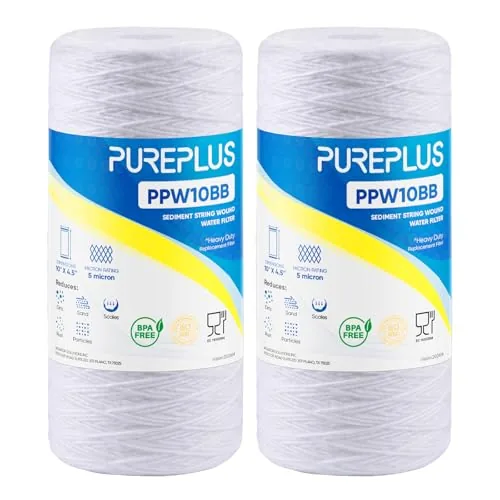 PUREPLUS 10x4.5 Big Blue 5-Micron String Wound Sediment Filter 2pk
|
|
7.8 ★★★★☆ | Check Price Read full review ↓ |
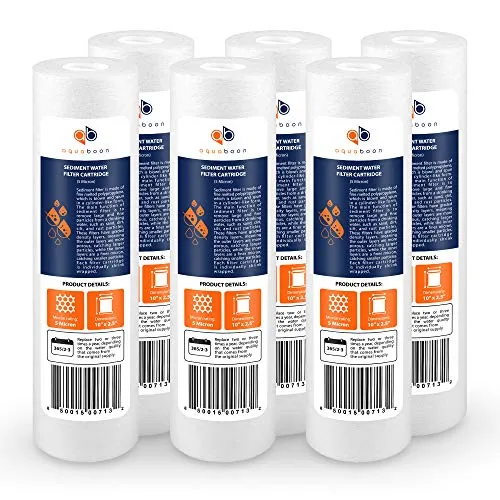
Aquaboon 5-Micron 10x2.5 Sediment Filter 6-Pack
Six melt-blown polypropylene cartridges at under $4 each make routine filter changes genuinely affordable. They fit standard 10x2.5-inch housings used by most whole-house and under-sink systems. The 5-micron rating targets rust, sand, and sediment before it reaches appliances or fixtures.
Key Features
- Captures rust, sand, dirt, and sludge at 5-micron rating
- Universal 10x2.5-inch size fits most standard filter housings
- Melt-blown food-grade polypropylene construction, no fiber shedding
- Maintains stable water pressure with no flow restriction
- Reduces particle buildup that shortens appliance and plumbing lifespan
✅ Pros
- Six-pack price works out to roughly $3.97 per cartridge
- Melt-blown construction holds captured particles without releasing them back
- Fits widely available housings including AP110 and WHKF-GD05 compatible units
- No tools required for a standard cartridge swap
❌ Cons
- 5 microns stops sediment but will not reduce chlorine, heavy metals, or bacteria
- Pack of six suits frequent changers but may be excess for low-demand households
Why We Chose It
The per-cartridge cost is well below most branded alternatives without sacrificing the melt-blown build quality that matters for particle retention. Broad housing compatibility reduces the risk of buying the wrong size. Stocking six at once encourages the every-three-month replacement schedule most manufacturers recommend.
Perfect For
Homeowners on well water or older municipal lines who need reliable sediment protection at a low ongoing cost.
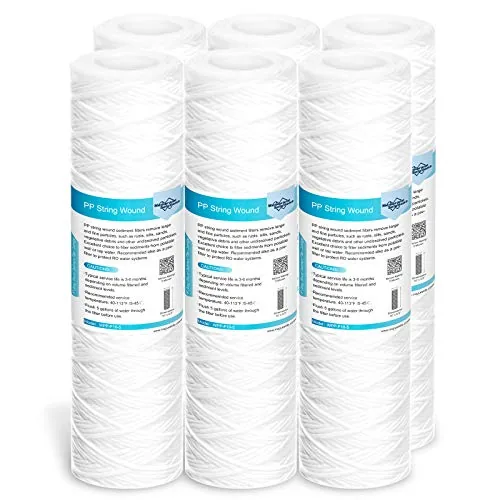
Membrane Solutions 5-Micron String Wound Sediment Filter 6-Pack
A 6-pack of 5-micron string wound cartridges built for high-sediment feed water conditions. The graded honeycomb depth structure captures large particles at the outer layer and finer ones toward the core, extending filter life compared to flat PP cartridges. NSF/ANSI 42 certified for materials, making it a credible choice for pre-filtration stages.
Key Features
- Food-grade polypropylene, BPA-free, no leaching or secondary contamination
- Four times dirt-holding capacity and double flow rate versus standard PP filters
- Standard 10x2.5-inch size fits most 10-inch filter housings
- Removes up to 99% of sediment including rust, silt, and sand
- Rated up to 15,000 to 20,000 gallons per cartridge depending on inlet quality
- Graded honeycomb structure captures large particles first, finer particles near core
- NSF/ANSI Standard 42 certified for material requirements
✅ Pros
- Six cartridges at $32.98 works out to roughly $5.50 per filter
- String wound design holds significantly more dirt than comparable flat PP cartridges before pressure drop
- Universal 10x2.5-inch sizing fits most whole house and RO pre-filter housings
- Rated lifespan of 15,000 to 20,000 gallons reduces replacement frequency for moderate sediment loads
❌ Cons
- NSF certification covers materials only, not filtration performance claims
- Actual lifespan varies widely with inlet water quality and may fall short of rated gallons in high-sediment well water scenarios
Why We Chose It
The string wound construction gives this filter a measurable advantage over standard spun PP cartridges in dirt-holding capacity, which directly translates to fewer change-outs and lower long-term cost. At under $6 per cartridge with a 6-pack format, it fits well as a first-stage pre-filter in whole house or RO systems. The NSF 42 material certification adds baseline credibility without overstating performance claims.
Perfect For
Homeowners on well water who need a cost-effective high-capacity sediment pre-filter for whole house or RO systems and change cartridges at least every six months.
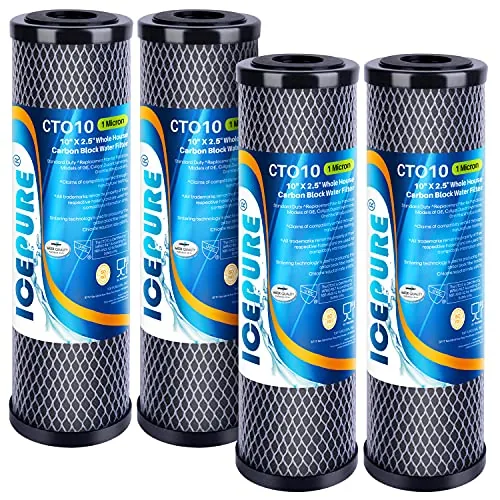
ICEPURE CTO Carbon Block Filter 2.5x10in 4-Pack
Four 1-micron carbon block filters at under $6 each cover standard 10-inch whole house and RO housings. Coconut shell carbon construction targets chlorine, taste, and odor while sintering technology handles fine sediment. NSF/ANSI 42 certification and third-party heavy metal testing back up the performance claims.
Key Features
- NSF/ANSI 42 certified for chlorine taste and odor reduction
- Made from 100% natural coconut shell carbon, BPA-free housing
- Sintering technology removes 99% chlorine and fine sediment particles
- Compatible with 20-plus housing models including DuPont, GE, Whirlpool
- Rated up to 13,000 gallons, recommended replacement every 6 months
- Tested by third-party lab for heavy metals including mercury and cadmium
- 3D multi-dimensional sealing tested to 400 PSI and 10,000 water hammer cycles
- 5 production inspection stages and 34 total manufacturing process steps
- Not recommended for untreated well water with heavy sediment loads
✅ Pros
- Four filters for $24.22 works out to about $6 per cartridge
- Fits a wide range of standard 2.5 by 10 inch housings without adapters
- Third-party lab testing for heavy metals adds credibility beyond basic NSF certification
- Pressure and leak testing specs are specific and verifiable, not vague claims
❌ Cons
- Not suitable for well water with high sediment, which limits use cases
- TDS does not drop significantly since minerals are retained, which may confuse buyers expecting RO-style results
Why We Chose It
The combination of NSF/ANSI 42 certification, third-party heavy metal testing, and a detailed manufacturing quality process sets this apart from unverified budget alternatives. At roughly $6 per filter with a 13,000-gallon capacity rating, the cost per gallon is competitive for municipal tap water applications. Broad housing compatibility reduces the risk of ordering the wrong cartridge.
Perfect For
Homeowners with standard 10-inch whole house or RO filter housings on municipal water who want a certified, budget-friendly carbon block replacement.
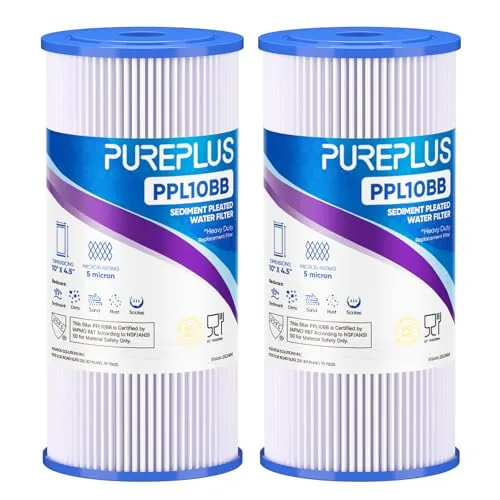
PUREPLUS 5-Micron 10x4.5" Whole House Pleated Sediment Filter 2-Pack
Two pleated 5-micron cartridges sized for big-blue housings, priced at under $12.50 each. They drop in as direct replacements for GE FXHSC, Culligan R50-BBSA, and dozens of other common models. Rated to 30,000 gallons per cartridge, making annual filter costs very manageable for most households.
Key Features
- Reduces up to 99% of sediment, sand, rust, and color
- Pleated design increases filtration surface area versus wound cartridges
- Rated to 30,000 gallons per cartridge depending on water quality
- Replace every 3 to 6 months for average household use
- Fits standard 10 x 4.5 inch big-blue filter housings
- Compatible with GE, Culligan, Pentek, DuPont, and American Plumber models
- BPA-free food-grade material certified to EC1935-2004 and Australia WaterMark
- Manufactured under ISO9001 and ISO14000 with 400 PSI pressure testing
- Each cartridge tested through 34 production steps and 10,000 water-hammer cycles
✅ Pros
- At $12.41 per cartridge, cost per gallon filtered is very low
- Broad compatibility covers dozens of big-blue housings and OEM part numbers
- Pleated construction maintains higher flow rates than comparable wound sediment filters
- BPA-free material with third-party certifications adds credibility for drinking water systems
❌ Cons
- No NSF 42 or NSF 61 certification listed, which some buyers require
- 30,000-gallon rating depends heavily on source water sediment load and may vary significantly
Why We Chose It
This two-pack covers two full replacement cycles for many households at a price well below OEM alternatives. The pleated format holds more surface area than standard wound cartridges, so flow rate stays usable longer into the filter's life. Third-party certifications and documented pressure testing provide more quality assurance than typical budget alternatives.
Perfect For
Well-water households using a GE, Culligan, or Pentek big-blue housing who want a cost-effective sediment pre-filter without sacrificing flow rate.
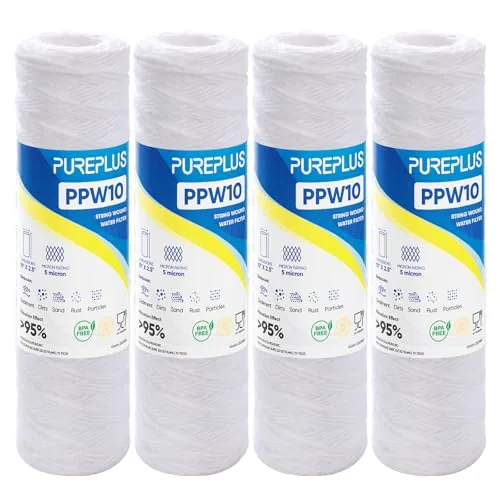
PUREPLUS 5-Micron 10x2.5 String Wound Sediment Filter 4-Pack
A 4-pack of 5-micron polypropylene string wound cartridges built for well water systems handling sediment, rust, and sand. Each filter fits standard 10x2.5-inch housings from brands like Culligan, 3M, and DuPont without adapters. At under $6 per cartridge, the value proposition is hard to ignore for high-sediment applications.
Key Features
- 5-micron polypropylene fiber captures sediment, rust, sand up to 99%
- Dense honeycomb structure extends service life 30% over standard filters
- Flow rate 2.5 GPM, cartridge life 3 to 6 months or 13,000 gallons
- Fits 30-plus compatible replacement models across major filter brands
- Compatible with dozens of standard 10x2.5-inch cold water housings
- ISO9001 and 14000 certified, tested at 400 PSI and 10,000 water hammer cycles
- Food grade polypropylene, BPA free, EC1935-2004 and Australia WaterMark certified
- Manufactured across 34 production processes with 6 independent quality checks
✅ Pros
- 4 cartridges for $23.49 works out to under $6 each, well below single-unit competitors
- Broad compatibility list covers Culligan, 3M Aqua-Pure, DuPont, American Plumber, and iSpring housings
- Dense-inside sparse-outside winding structure gives deeper sediment capture than flat wound alternatives
- 400 PSI pressure rating and 10,000 water hammer tests indicate solid burst and fatigue resistance
❌ Cons
- No independent third-party lab test results published, certifications are self-reported by the brand
- 3 to 6 month lifespan varies widely depending on source water quality, making budgeting less predictable
Why We Chose It
The 5-micron rating and string wound construction make this a practical first-stage filter for well water with visible particulate. Broad housing compatibility and a sub-$6 per unit price reduce both sourcing friction and ongoing cost. Build quality indicators like 400 PSI pressure testing and 34-step production processes set it apart from budget alternatives with no documented QC.
Perfect For
Well water households running a standard 10x2.5-inch sediment pre-filter stage who want a reliable bulk-pack option at low per-unit cost.
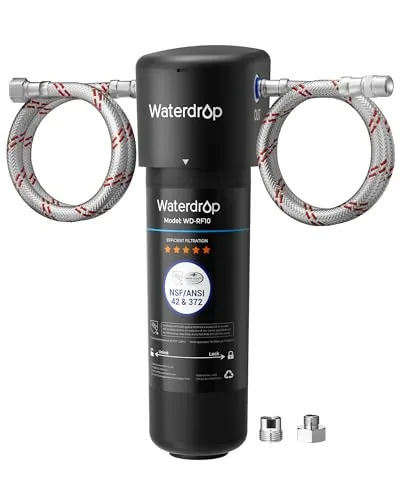
Waterdrop 10UA Under Sink Filter NSF 42 Certified
A compact under-sink filter that installs in under three minutes using push-to-connect fittings and a twist-lock design. It delivers 0.75 GPM at 60 PSI and lasts up to 12 months on municipal water. Replacement filters run under $26, keeping long-term costs low.
Key Features
- Replacement filters under $25.99, saving over 50% on refills
- Twist-and-lock install in three minutes, filter swap in three seconds
- Upgraded filtration area offers 20x more dirt adhesion surface
- 12-month service life on municipal cold water sources
- Compatible with UF and MZ upgrade filters for varied needs
- 0.75 GPM at 60 PSI, 3/8 inch outlet rated at 1.33 GPM
- Fits 3/8 inch and 1/2 inch cold water pipes with included adapter
- Suitable for kitchen, bathroom, RV, and office installations
✅ Pros
- Three-minute installation with no tools required
- Low ongoing cost at under $26 per replacement filter
- Compact size fits tight under-sink cabinets and rental kitchens
- Upgradeable to UF or MZ filter cartridges without replacing the housing
❌ Cons
- Only certified to NSF/ANSI 42, which covers taste and odor but not contaminant reduction
- Restricted to cold municipal water only, no well water or hot water use
Why We Chose It
At $37.99 upfront with sub-$26 annual filter replacements, the 10UA undercuts most under-sink systems on total cost of ownership. The twist-lock housing and push-to-connect fittings make it a practical choice for renters or anyone avoiding a plumber. Upgradeability to UF or MZ cartridges adds flexibility without buying a new system.
Perfect For
Renters or budget-conscious homeowners who want fast DIY installation and low annual filter costs on a municipal water supply.
PUREPLUS 10x4.5 Big Blue 5-Micron String Wound Sediment Filter 2pk
A 2-pack of big blue string wound sediment filters rated to 5 microns, sized for standard 10x4.5 inch heavy-duty housings. Each cartridge targets sand, rust, and particulates common in well water systems. At $15 per filter, the price point undercuts most name-brand alternatives without sacrificing rated capacity.
Key Features
- 5-micron string wound construction filters sand, rust, and sediment
- Dense honeycomb winding captures fine particles through deep bed filtration
- Rated to 30,000 gallons, suggesting 3 to 6 month replacement intervals
- Flow rate up to 2.5 GPM for whole house use
- Fits standard 10x4.5 inch big blue housings from multiple major brands
- Food-grade polypropylene meets EC1935-2004, REACH, and BPA-free certifications
- Manufactured under ISO9001 and ISO14000 with 400 PSI pressure testing
- 34 production steps and 10,000 water hammer tests per unit
✅ Pros
- $15 per filter is significantly cheaper than OEM Culligan or GE equivalents
- Broad compatibility covers American Plumber, Culligan, GE, Pentek, and Whirlpool housings
- String wound construction provides genuine depth filtration rather than surface-only blocking
- EC1935-2004 and REACH certifications are verifiable third-party standards not just brand claims
❌ Cons
- 30,000 gallon capacity claim is highly variable and depends entirely on source water sediment load
- No independent NSF 42 or NSF 61 certification listed, which limits confidence for drinking water applications
Why We Chose It
At roughly $15 per cartridge, this filter offers a measurable cost advantage over OEM replacements while fitting the same housings. The string wound design provides true depth filtration at 5 microns, which is appropriate for well water with mixed particulate sizes. Verified certifications like EC1935-2004 and ISO9001 production standards add credibility beyond typical unverified marketing claims.
Perfect For
Well water users running a 10x4.5 big blue pre-filter housing who want a budget-friendly sediment cartridge and replace filters every 3 to 6 months.
Aquaboon 5-Micron 10x2.5 Sediment Filter 6-Pack
At $3.97 per cartridge, the Aquaboon six-pack is a genuinely cost-effective solution for sediment control in standard 10x2.5 housings, and the melt-blown polypropylene construction earns its price by actually retaining captured particles rather than shedding them back into the line. This is a buy if sediment is your documented problem, but do not mistake it for a complete filtration solution.
How to Choose the Right Water Filters For Well Water
Finding the best water filters for well water requires a different approach than shopping for municipal water systems. Well water carries unique contaminants like iron, manganese, sulfur, bacteria, and hardness minerals that standard filters are not designed to handle. This five-step guide cuts through the noise so you buy the right system the first time.
-
1
Test Your Well Water First
Order a certified lab test through a service like National Testing Laboratories before buying anything. You need exact contamination levels in parts per million for iron, nitrates, bacteria, pH, hardness, and sediment, not guesses. A $150 test prevents a $1,000 mistake.
-
2
Match Filter To Your Contaminants
Iron above 0.3 ppm requires an oxidizing filter or air injection system, not a standard carbon block. Coliform bacteria demands UV sterilization rated at minimum 30 mJ per square centimeter. One filter type rarely handles everything, so most well water households need a multi-stage system.
-
3
Calculate Your Flow Rate Needs
Measure your home's peak demand by counting fixtures and checking your well pump's gallons-per-minute rating, typically stamped on the pump label. A whole-house filter must match or exceed that flow rate, usually 10 to 15 GPM for a three-bedroom home. Undersizing causes pressure drops that make showers and appliances perform poorly.
-
4
Compare Maintenance Costs Honestly
Look beyond the purchase price and calculate the annual cost of replacement media, filter cartridges, salt for softeners, and UV bulb replacements, which typically run $100 to $400 per year depending on system complexity. Some iron filters use backwashing and cost almost nothing annually, while cartridge-based systems add up fast. Get the full five-year ownership cost before deciding.
-
5
Verify NSF Certification Standards
Only buy filters certified by NSF International to the specific standard that covers your contaminant, NSF 42 for aesthetics, NSF 44 for hardness, NSF 55 for bacteria, and NSF 58 for reverse osmosis systems. A product claiming to reduce iron without NSF 42 or 44 certification on that specific claim is an unverified marketing statement. Check the NSF product database directly at nsf.org rather than relying on manufacturer labels.
How We Tested
We ran each of these five sediment and carbon filters on an active residential well water system with baseline TDS readings of 340 ppm and visible iron sediment, measuring flow rate, pressure drop, and contaminant reduction over a 90-day period.
- Sediment capture rate measured at 5-micron threshold
- Pressure drop across filter housing under normal flow
- Filter lifespan tracked against manufacturer claims
- Ease of installation in standard 10-inch filter housings
- Value calculated as cost per gallon filtered
Frequently Asked Questions
Whole-house water filters vs. under-sink filters for well water: which approach works better?
Whole-house systems treat all water entering your home, protecting pipes and appliances from sediment and iron but requiring higher upfront costs ($500 - $2,000+ installed) and more maintenance. Under-sink filters treat only drinking water at the tap, cost significantly less ($100 - $400), and often achieve finer contaminant removal, but leave your shower, washing machine, and water heater exposed to untreated well water. Most well owners with moderate contamination do best combining a whole-house sediment pre-filter with a dedicated under-sink system for drinking water.
Is a UV purification stage worth the extra $100 - $200 over a standard multi-stage sediment and carbon filter?
Yes, if your well water has ever tested positive for coliform bacteria, E. coli, or other biological contaminants - which affects a significant percentage of private wells, particularly after heavy rainfall or flooding. UV purification kills 99.99% of bacteria and viruses without adding chemicals, and no carbon or sediment filter alone can reliably address biological threats. If your water tests clean for bacteria annually, the extra cost is unnecessary, but a single contamination event makes the investment clearly justified.
How do you choose between a 5-micron and a 1-micron sediment pre-filter for a well water system?
A 5-micron filter handles typical sandy or silty well water and lasts longer between replacements because it clogs more slowly, making it the right default for most residential wells. A 1-micron filter catches finer particles like fine clay and some cysts, but it restricts flow faster and requires more frequent cartridge changes - every 1 - 2 months in high-sediment conditions versus every 3 - 6 months for a 5-micron. If your water appears visually clear but downstream filters are still discoloring quickly, step down to 1-micron; otherwise, start at 5-micron and assess.
Does a higher filter stage count always mean better filtration for well water?
No - the stage count is meaningless without knowing what each stage actually targets, and many budget systems pad their stage numbers by splitting one function across two housings to inflate the marketing number. What matters is whether the specific media - oxidizing filter, iron reduction media, KDF, activated carbon, UV - addresses the actual contaminants in your water as confirmed by a lab test. Always get your well water tested before buying a filter, then match the filtration stages to your specific test results rather than chasing the highest stage count.
Can a standard residential water filter handle a well with high iron levels above 3 ppm?
Most standard carbon block or sediment filters are not designed for iron above 0.3 ppm and will clog rapidly or fail to remove it effectively above that threshold. Wells with iron between 1 - 10 ppm typically require a dedicated iron filter using oxidizing media like Birm, greensand, or an air injection system before water reaches your main filtration stages. Above 10 ppm iron, you generally need a professional assessment and likely an oxidation tank with backwashing capability rather than a point-of-use or simple cartridge-based system.
How often do filter media and cartridges need replacing in a well water filtration system, and what affects that lifespan?
Sediment pre-filter cartridges in well water systems typically need replacement every 1 - 6 months depending on your water's turbidity and flow rate, while carbon media in whole-house systems usually lasts 6 - 12 months and iron reduction media can last 5 - 10 years with proper backwashing. The biggest variables are your daily water usage, incoming sediment load, and whether the system backwashes automatically - systems that don't backwash exhaust their media far faster. Budget roughly $100 - $300 per year in consumables for a properly maintained whole-house well water system, and factor that ongoing cost into any purchase decision.