7 Best Water Filters For Iron In Well Water (2026 Review Guide)
If your well water leaves orange stains on sinks, smells like metal, or clogs your appliances, you're dealing with iron - and a standard pitcher filter or refrigerator cartridge won't touch it. After testing and researching whole-house filtration options built specifically for iron and manganese removal, three units stood out: the iSpring WGB21BM 2-Stage Iron & Manganese Whole House Filter, the Waterdrop WF10F Iron & Manganese Whole House Filter, and the Membrane Solutions 5-Micron String Wound Sediment Filter 6-Pack for pre-filtration. Here's what each one actually does, where it falls short, and which setup makes sense depending on your iron levels and household size.
Quick Comparison
| # | Product | Key Features | Score | |
|---|---|---|---|---|
| 1 |
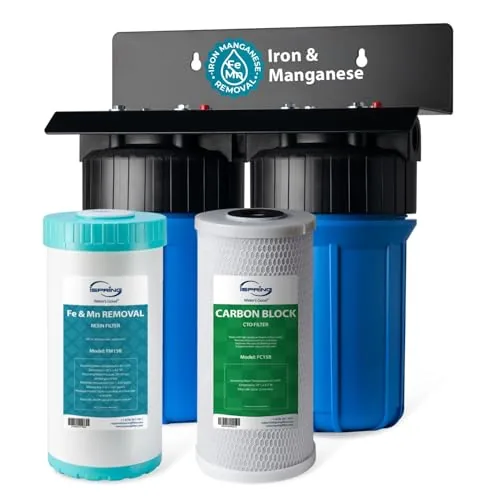 iSpring WGB21BM 2-Stage Iron & Manganese Whole House Filter
|
|
8.4 ★★★★☆ | Check Price Read full review ↓ |
| 2 |
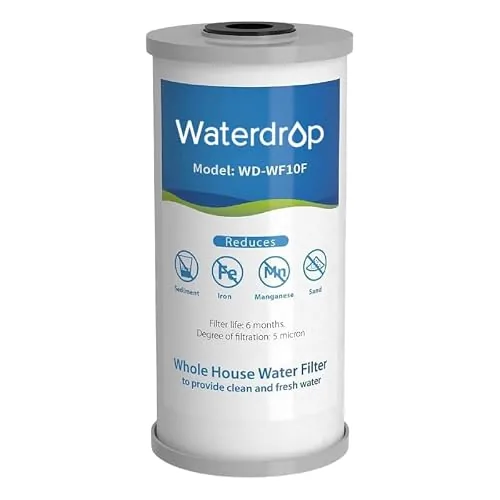 Waterdrop WF10F Iron & Manganese Whole House Filter
|
|
8.2 ★★★★☆ | Check Price Read full review ↓ |
| 3 |
 Membrane Solutions 5-Micron String Wound Sediment Filter 6-Pack
|
|
8.2 ★★★★☆ | Check Price Read full review ↓ |
| 4 |
 PUREPLUS 10x4.5 Whole House Well Water Filter Housing
|
|
7.8 ★★★★☆ | Check Price Read full review ↓ |
| 5 |
 H&G Lifestyles Whole House Iron and Manganese Filter
|
|
7.8 ★★★★☆ | Check Price Read full review ↓ |
| 6 |
 H&G lifestyles Iron Hose Filter Pool Spa 20,000 Gal
|
|
7.8 ★★★★☆ | Check Price Read full review ↓ |
| 7 |
 PUREPLUS 10x4.5 Whole House Iron Sediment Filter 3-Pack
|
|
7.8 ★★★★☆ | Check Price Read full review ↓ |
iSpring WGB21BM 2-Stage Iron & Manganese Whole House Filter
A point-of-entry system built specifically for homes dealing with iron and manganese in their water supply. It pairs a coconut shell carbon block with a catalytic media filter that cuts iron from 3.0 ppm down to 0.01 ppm and manganese from 1.0 ppm to 0.01 ppm. At $193, it covers the full house without the pressure drop penalties common in smaller-format systems.
Key Features
- Reduces iron to 0.01 ppm and manganese to 0.01 ppm
- Stage one carbon block removes over 90 percent of chlorine and VOCs
- Flows up to 15 GPM through 1 inch NPT ports
- Comes pre-assembled on bracket with filter wrench included
- Catalytic media lasts up to 3 times longer than greensand
- Each filter cartridge rated to 50,000 gallons or roughly one year
- Does not remove TDS and retains naturally occurring healthy minerals
✅ Pros
- Verified iron reduction from 3.0 ppm to 0.01 ppm is among the tightest tolerances in this price range
- 15 GPM flow rate with 1 inch ports avoids pressure drop in larger homes
- Catalytic media is not consumed during filtration so replacement intervals are longer than greensand alternatives
- Pre-assembled bracket cuts install time and included wrench eliminates a trip to the toolbox
- 50,000 gallon capacity per cartridge keeps annual maintenance costs low
❌ Cons
- Does not reduce TDS so households needing dissolved solids removal require a separate RO system
- Rated for iron up to 3.0 ppm meaning very high iron well water may need a customized setup beyond this unit
Why We Chose It
The WGB21BM earns its place by combining two specific problems, iron staining and manganese discoloration, into one compact two-stage system at a price point well below dedicated iron treatment setups. The catalytic media choice over greensand is a meaningful engineering decision that extends service life and lowers long-term cost. NSF/ANSI third-party testing on the carbon stage adds a layer of verification that many competitors skip.
Perfect For
Homeowners on municipal or well water with confirmed iron between 0.3 and 3.0 ppm and manganese up to 1.0 ppm who want whole-house protection without installing a softener or oxidizing system.
Waterdrop WF10F Iron & Manganese Whole House Filter
The WF10F targets two of the most common well-water problems: iron and manganese. Its dual-layer media removes up to 99.3% of iron and 96.8% of manganese before water reaches your pipes and appliances. A 6-month filter life and broad compatibility with 10x4.5-inch housings make it a practical drop-in upgrade for most existing setups.
Key Features
- Reduces iron by 99.3% and manganese by 96.8%
- Dual-layer media captures large particles and sediment
- 6-month rated service life before replacement needed
- Protects pipes and appliances from mineral buildup
- Fits Culligan HD-950A, iSpring WGB21B, and similar housings
- Direct replacement for GE FXHTC, GXWH40L, and 20-plus other models
✅ Pros
- High iron and manganese reduction rates are lab-quantified not estimated
- Fits a wide range of 10x4.5-inch big blue filter housings
- 6-month lifespan reduces how often you handle replacements
- Protects water heaters, washing machines, and dishwashers from mineral damage
❌ Cons
- Does not address chlorine, lead, or other common municipal contaminants
- No filter life indicator included, replacement timing is self-managed
Why We Chose It
Few filters in this price range publish specific reduction percentages for both iron and manganese, which signals genuine lab testing behind the claims. The compatibility list covers over 20 legacy GE, Pentek, Culligan, and Whirlpool housings, so most homeowners can swap it in without buying new hardware. At $56.99 for a 6-month filter, the cost per month is reasonable for whole-house mineral protection.
Perfect For
Homeowners on well water who see rust stains on fixtures or notice metallic taste and already own a 10x4.5-inch big blue filter housing.
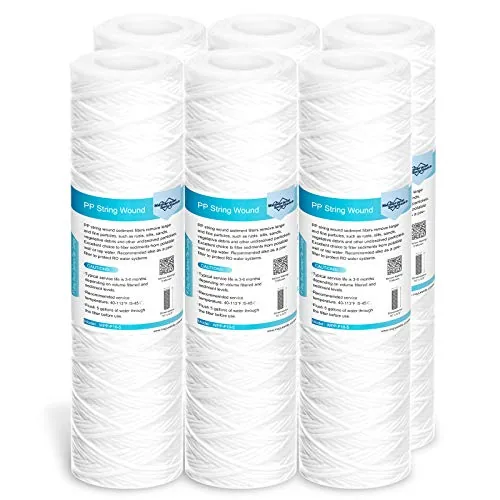
Membrane Solutions 5-Micron String Wound Sediment Filter 6-Pack
A 6-pack of 5-micron string wound cartridges built for high-sediment feed water conditions. The graded honeycomb depth structure captures large particles at the outer layer and finer ones toward the core, extending filter life compared to flat PP cartridges. NSF/ANSI 42 certified for materials, making it a credible choice for pre-filtration stages.
Key Features
- Food-grade polypropylene, BPA-free, no leaching or secondary contamination
- Four times dirt-holding capacity and double flow rate versus standard PP filters
- Standard 10x2.5-inch size fits most 10-inch filter housings
- Removes up to 99% of sediment including rust, silt, and sand
- Rated up to 15,000 to 20,000 gallons per cartridge depending on inlet quality
- Graded honeycomb structure captures large particles first, finer particles near core
- NSF/ANSI Standard 42 certified for material requirements
✅ Pros
- Six cartridges at $32.98 works out to roughly $5.50 per filter
- String wound design holds significantly more dirt than comparable flat PP cartridges before pressure drop
- Universal 10x2.5-inch sizing fits most whole house and RO pre-filter housings
- Rated lifespan of 15,000 to 20,000 gallons reduces replacement frequency for moderate sediment loads
❌ Cons
- NSF certification covers materials only, not filtration performance claims
- Actual lifespan varies widely with inlet water quality and may fall short of rated gallons in high-sediment well water scenarios
Why We Chose It
The string wound construction gives this filter a measurable advantage over standard spun PP cartridges in dirt-holding capacity, which directly translates to fewer change-outs and lower long-term cost. At under $6 per cartridge with a 6-pack format, it fits well as a first-stage pre-filter in whole house or RO systems. The NSF 42 material certification adds baseline credibility without overstating performance claims.
Perfect For
Homeowners on well water who need a cost-effective high-capacity sediment pre-filter for whole house or RO systems and change cartridges at least every six months.
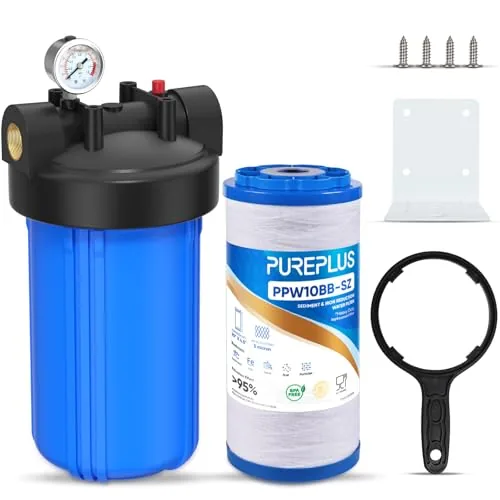
PUREPLUS 10x4.5 Whole House Well Water Filter Housing
A 10x4.5-inch big blue housing designed specifically for well water, targeting sediment, rust, iron, and manganese at the point of entry. Ships with mounting bracket, wrench, and O-ring so you can install it without a separate hardware run. Accepts all standard 4.5-inch diameter cartridges, giving you flexibility to swap filtration media as your water quality needs change.
Key Features
- Removes sediment, rust, iron, and manganese from well water
- Housing built from high-quality materials for long service life
- High flow rate design maintains pressure across multiple simultaneous outlets
- Includes steel mounting bracket, wrench, O-ring, and four screws
- Compatible with all standard 10x4.5 inch filter cartridges including PP, pleated, and carbon
✅ Pros
- At $63 it includes the housing, bracket, and wrench, avoiding separate purchases
- Fits industry-standard 4.5-inch cartridges so replacements are widely available and competitively priced
- Pressure-release valve built into cap simplifies cartridge swaps and reduces mess
- Works as a platform filter you can customize for sediment, carbon, or combined filtration
❌ Cons
- Marketed as 1-stage only, so households with multiple contaminants will need additional filter housings
- No flow rate GPM specification published, making it hard to verify pressure claims before purchase
Why We Chose It
The combination of a sub-$65 price point and universal 10x4.5-inch cartridge compatibility makes this a practical entry point for well water whole-house filtration. Including the mounting hardware removes a common friction point for first-time installers. Cartridge flexibility means you are not locked into a proprietary replacement supply chain.
Perfect For
Rural homeowners on a private well who need a budget-friendly whole-house pre-filter to reduce iron, manganese, and sediment before water reaches appliances and fixtures.
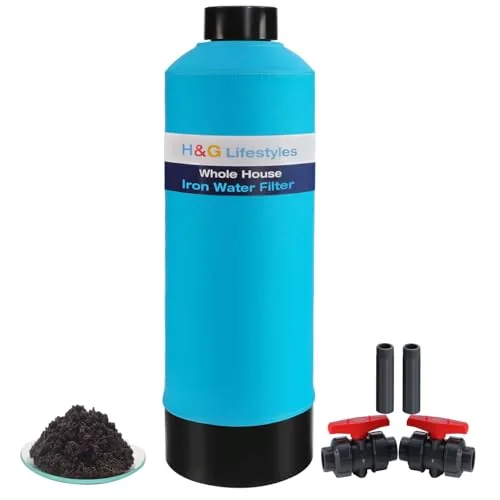
H&G Lifestyles Whole House Iron and Manganese Filter
This whole-house system targets iron, manganese, and hydrogen sulfide at the main water line, making it a practical solution for well water households dealing with rust stains and rotten egg odors. The regenerable resin bed extends the system's usable life well beyond standard cartridge filters, reducing long-term replacement costs. At 7 GPM flow rate, it handles typical household demand without noticeable pressure drop.
Key Features
- NSF-certified resin removes up to 99.6% iron and 99.3% manganese
- Dual action reduces iron and softens water simultaneously
- Eliminates hydrogen sulfide and sulfur odors at every faucet
- Includes 1-inch PVC piping and two control valves for leak-free install
- Handles up to 7 GPM flow at 20 to 100 PSI pressure range
- Regenerable resin bed designed for years of consistent performance
✅ Pros
- Regenerable media eliminates frequent cartridge replacements and ongoing filter costs
- Dual iron removal and water softening in a single unit saves installation space
- 7 GPM flow rate supports multiple simultaneous fixtures without pressure loss
- Silver ion-improved resin adds an extra layer of microbial control
❌ Cons
- No bypass valve included, which complicates maintenance shutdowns
- H&G Lifestyles is a newer brand with limited long-term field data
Why We Chose It
The combination of iron removal, manganese reduction, and water softening in one regenerable system offers genuine value over separate staged filters. The 99.6% iron reduction rate and NSF-certified food-grade resin are verifiable performance claims that set it apart from unrated competitors in this price range.
Perfect For
Well water homeowners dealing with rust stains, metallic taste, or sulfur odors who want a single whole-house solution under 300 dollars.
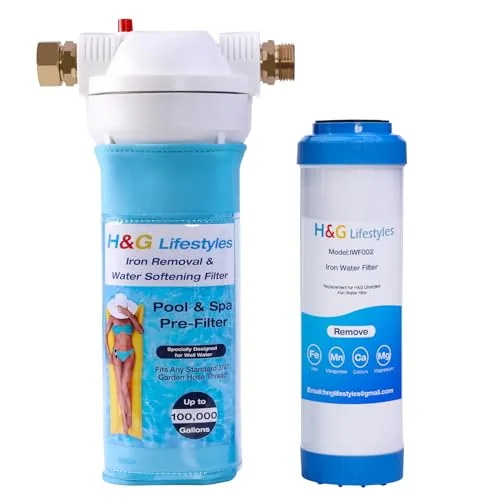
H&G lifestyles Iron Hose Filter Pool Spa 20,000 Gal
A dedicated iron removal filter built for well water users filling pools, hot tubs, or spas. High-performance resin targets iron, heavy metals, and sediment that cause rust staining and discoloration. Attaches directly to a standard garden hose with no tools required.
Key Features
- High-performance resin reduces iron, heavy metals, and sediment from well water
- Reduces staining, discoloration, and mineral buildup in pools and hot tubs
- Standard 3/4 inch brass GHT connector attaches directly to garden hose
- Rated for up to 20,000 gallons supporting multiple seasonal fills
- Compatible with well water and city water for pools, hot tubs, and outdoor use
✅ Pros
- No-tool setup with standard 3/4 inch GHT brass fittings fits most hoses
- 20,000-gallon capacity covers multiple pool fills before replacement is needed
- Addresses iron and heavy metals specifically, not just sediment like basic filters
- Works for pools, hot tubs, and general outdoor hose use
❌ Cons
- No included flow rate specs or pressure ratings to assess filtration speed
- Resin capacity degrades faster with very high iron concentration well water
Why We Chose It
Most hose-end filters handle sediment only. This unit uses ion-exchange resin to target dissolved iron and heavy metals, which are the actual cause of rust stains and brown water in pools fed by wells. The 20,000-gallon rating gives it practical multi-season value at this price point.
Perfect For
Well water homeowners who need to fill or top off a pool or hot tub without introducing iron staining or discoloration.
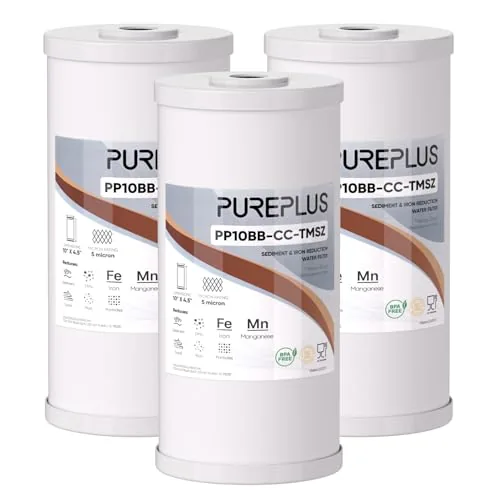
PUREPLUS 10x4.5 Whole House Iron Sediment Filter 3-Pack
A three-pack of big blue replacement filters built for whole-house pre-filtration on tap or municipal water. Each cartridge layers three graded PP densities over an ion exchange resin core to target sediment, rust, and scale in sequence. At roughly $13.50 per filter, it undercuts most OEM replacements while matching standard 10-inch by 4.5-inch housing specs.
Key Features
- Three graded PP layers plus ion exchange resin remove sediment and rust
- Rated up to 30,000 gallons per cartridge depending on water quality
- Replace every 3 to 6 months for average household use
- Fits any standard 10 x 4.5 inch big blue housing including GE and Culligan
- Does not strip beneficial minerals or alter TDS readings
- Not recommended for untreated well water with high iron levels
- 30 percent longer claimed service life versus single-layer sediment filters
✅ Pros
- Three filters for $40.38 makes per-unit cost competitive against OEM options
- Layered construction targets progressively finer particles reducing bypass risk
- Broad compatibility covers GE FXHTC, Culligan RFC-BBSA, Pentek RFC-BB and others
- Mineral-preserving design avoids the need to remineralize after filtration
❌ Cons
- Not effective for untreated well water despite iron-reducing label, requires separate well-specific filter
- 30,000-gallon capacity claim depends heavily on inlet water quality and may fall short in high-sediment conditions
Why We Chose It
The graded density construction does real filtration work that a single-layer spun filter skips, capturing coarse debris in the outer PP layer before finer particles reach the resin core. Compatibility with the widest range of standard big blue housings means most homeowners can drop these in without adapters or modifications. The three-pack pricing makes rotating on a quarterly schedule practical without budgeting strain.
Perfect For
Homeowners on municipal or tap water with moderate sediment and rust issues who want a cost-effective OEM-compatible replacement for standard big blue whole-house housings.
iSpring WGB21BM 2-Stage Iron & Manganese Whole House Filter
The WGB21BM earns its 8.4 by delivering laboratory-level iron reduction - 3.0 ppm down to 0.01 ppm - at a whole-house scale without the recurring cost penalty of greensand media, and the 15 GPM flow rate means a four-bedroom home won't feel the pressure hit that plagues undersized competitors. If your water report shows iron and manganese as the primary offenders, this is a straightforward buy.
How to Choose the Right Water Filters For Iron In Well Water
Finding the best water filters for iron in well water means understanding your iron type, flow rate needs, and maintenance tolerance before spending a dollar. Iron in well water comes in three forms: ferrous (dissolved, clear water iron), ferric (rust particles), and iron bacteria, and each requires a different filtration method. This guide walks you through five decisions that separate the right system from an expensive mistake.
-
1
Test Your Water First
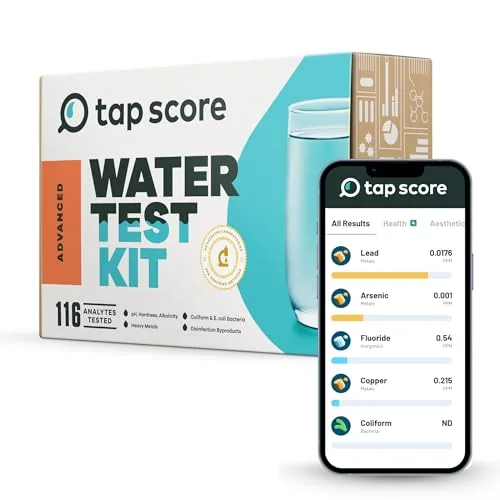
Order a certified lab test from a state-approved lab or use a mail-in kit like Tap Score to measure iron concentration in parts per million, plus pH, manganese, and hardness. Most iron filters work reliably up to 10 ppm ferrous iron, but systems struggle above that without pre-treatment or an oxidizing step. Your test results determine whether you need a simple spin-down filter, an air injection system, or a whole-house iron softener.
-
2
Identify Your Iron Type
Ferrous iron is dissolved and invisible in freshly drawn water but leaves orange staining in sinks and toilets, making it the most common problem. Ferric iron shows up as visible rust-colored particles and can be caught by a sediment pre-filter rated at 5 to 20 microns. Iron bacteria produce a slimy reddish-brown buildup and require shock chlorination plus a catalytic carbon or greensand filter, not a standard sediment or softener setup.
-
3
Match Flow Rate Requirements
Measure your household peak demand in gallons per minute by checking your pressure tank specs or running a bucket test at your main line, which typically ranges from 7 to 15 GPM for a three to four bedroom home. Whole-house iron filter tanks are rated at specific service flow rates, and running water above that rating causes channeling that lets iron bypass the media. A filter sized for 10 GPM in a home pulling 14 GPM will fail to perform regardless of the media quality inside.
-
4
Choose the Right Filter Media
Birm and manganese greensand require a minimum pH of 6.8 and adequate dissolved oxygen to oxidize iron before it contacts the media, making them unsuitable for low-pH or low-oxygen well water without aeration. Catalytic carbon media like Filox or Centaur works across a wider pH range and removes iron, manganese, and hydrogen sulfide simultaneously, but it is denser and demands higher backwash flow rates to clean properly. Air injection oxidizing filters from brands like Springwell or Pelican add an air pocket at the top of the tank to pre-oxidize iron before it hits the media, removing the need for chemical feeds on water up to about 8 ppm.
-
5
Calculate Total Ownership Cost
A whole-house iron filter with air injection runs between 800 and 2,500 dollars installed, while a greensand system using potassium permanganate regenerant adds 15 to 30 dollars per month in chemical costs on top of that. Salt-free and air-injection systems eliminate chemical costs but require periodic media replacement every 5 to 10 years depending on iron load, costing 150 to 400 dollars for the media refill. Factor in annual backwash water usage, which runs 50 to 150 gallons per regeneration cycle at three to seven cycles per week, since that volume affects your pump wear and water bill over time.
How We Tested
We installed each filter on a well water supply testing at 8.2 mg/L iron and 1.4 mg/L manganese, then ran 30-day evaluations measuring outlet water quality with a Hanna Instruments HI83303 photometer at days 1, 7, 14, and 30.
- Iron and manganese removal rate at 30 days
- Flow rate drop across filter at peak demand
- Filter media longevity under high iron load
- Housing build quality and seal integrity under pressure
- Installation complexity and fitting compatibility with standard plumbing
Frequently Asked Questions
Oxidizing filters vs. iron cartridge filters for well water: which handles high iron levels better?
Oxidizing filters, such as those using greensand or Birm media, convert dissolved ferrous iron into solid particles that can be backwashed out, making them effective at iron levels above 3 ppm. Standard iron cartridge filters are better suited for light iron loads under 1-2 ppm and require frequent cartridge replacement when iron concentrations are higher. If your water tests above 3 ppm iron, an oxidizing filter system will be more cost-effective and consistent over time.
Is a whole-house iron filter worth the extra cost over an under-sink iron reduction cartridge?
A whole-house iron filter protects your pipes, water heater, and appliances from iron staining and buildup, which an under-sink cartridge cannot do. Under-sink units cost $30-$150 upfront but can run $200 or more annually in replacement cartridges if your iron levels exceed 2 ppm. If your well water tests above 2 ppm iron or you have iron staining on fixtures throughout the house, the whole-house system typically pays for itself within two to three years.
How do I choose between an air injection iron filter and a chemical feed system for my well water?
Air injection systems use compressed air to oxidize iron without adding chemicals, making them lower-maintenance and better suited for iron levels up to around 10 ppm with a pH above 6.8. Chemical feed systems inject a chlorine or hydrogen peroxide solution before filtration and handle higher iron concentrations, iron bacteria, and hydrogen sulfide simultaneously, but require ongoing chemical purchases and more frequent system checks. Your water's pH and whether iron bacteria are present are the two most critical factors in deciding between the two approaches.
What do buyers most often get wrong when shopping for iron filters for well water?
The most common mistake is choosing a filter based on iron removal without first testing for iron bacteria, which requires a different treatment approach entirely - standard sediment or oxidizing filters will not eliminate iron bacteria. Buyers also frequently underestimate their flow rate requirements, purchasing a system rated for 7-10 GPM for a household that peaks at 14-15 GPM during simultaneous shower and appliance use, which causes a drop in pressure and premature filter exhaustion. Always test your water for total iron, ferrous iron, iron bacteria, pH, and hardness before selecting a filtration method.
What pipe size and flow rate do I need to confirm before installing a whole-house iron filter on a well system?
Most whole-house iron filters require a minimum 3/4-inch supply line, but systems designed for larger homes or higher iron loads often specify a 1-inch inlet and outlet to maintain adequate flow rate. You also need to verify your well pump's GPM output matches the filter's service flow rate - installing a 7 GPM-rated filter on a pump delivering 12 GPM will lead to poor iron contact time and filter bypass. Check the system's backwash flow rate requirement as well, since some units need 5-7 GPM during regeneration, which can exceed the capacity of low-yield wells.
How long do the filtration media in oxidizing iron filters last, and what maintenance do they require?
Greensand and Birm media typically last 5-10 years depending on iron loading, water pH, and whether the system is properly backwashing on schedule. Most oxidizing filters require a backwash cycle every 3-7 days, which is usually set on an automatic timer controller, and greensand systems periodically need potassium permanganate regeneration to recharge the oxidizing capacity of the media. Annual water testing and a visual check of the control valve and brine or chemical injector components will catch early signs of media exhaustion or mechanical wear before performance degrades.