6 Best Water Filters For Camping (2026 Review Guide)
Finding the best water filters for camping comes down to three practical questions: How much water do you need to filter, how much weight can you carry, and what contaminants are you most likely to encounter on your specific trips? After testing straw-style filters, squeeze systems, and inline filters across backcountry trails and RV campsites, three options consistently stood out for different types of campers: the LifeStraw Personal Water Filter with its 1,000-gallon capacity, the Sawyer Squeeze paired with the Cnoc 2L TPU Bladder for hands-free filtration, and the Camco TastePure Inline Filter for RV hookups where taste and sediment are the primary concerns. Here is what separates them and which one is worth your money based on how you actually camp.
Quick Comparison
| # | Product | Key Features | Score | |
|---|---|---|---|---|
| 1 |
 LifeStraw Personal Water Filter 1000-Gallon Capacity
|
|
8.7 ★★★★☆ | Check Price Read full review ↓ |
| 2 |
 Sawyer Squeeze + Cnoc 2L TPU Bladder Water Filter
|
|
8.5 ★★★★☆ | Check Price Read full review ↓ |
| 3 |
 Camco TastePure RV Inline Water Filter GAC & KDF
|
|
8.2 ★★★★☆ | Check Price Read full review ↓ |
| 4 |
 Practical Survival Water Filter Straw 5-Pack 1800gal
|
|
8.2 ★★★★☆ | Check Price Read full review ↓ |
| 5 |
 Waterdrop Gravity Filter Straw with 1.5-Gal Bag
|
|
8.2 ★★★★☆ | Check Price Read full review ↓ |
| 6 |
 Camco TastePure RV Water Filter 2-Pack GAC & KDF
|
|
8.2 ★★★★☆ | Check Price Read full review ↓ |
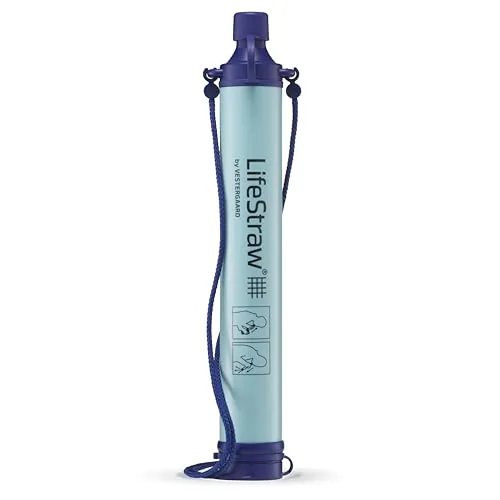
LifeStraw Personal Water Filter 1000-Gallon Capacity
At $14.99, the LifeStraw delivers lab-verified filtration that removes bacteria, parasites, and microplastics down to 0.2 microns. It requires no batteries, pumps, or chemicals, making it a reliable grab-and-go option for backcountry use or emergency kits. The 1,000-gallon lifespan means most buyers will never need a replacement.
Key Features
- Removes 99.999999% of bacteria including E. coli and Salmonella
- Removes 99.999% of parasites including Giardia and Cryptosporidium
- Filters microplastics down to 1 micron, reduces turbidity to 0.2 microns
- Testing verified by US EPA, NSF, and ASTM standard protocols
- Rated for 4,000 liters (1,000 gallons) of filtered water
- BPA-free construction; each purchase funds a school child's water access for one year
✅ Pros
- Filtration claims independently verified by EPA and NSF standard testing
- 4,000-liter lifespan covers years of occasional outdoor use at this price point
- Compact and lightweight with no moving parts or consumables to replace
- Removes microplastics down to 1 micron, a capability rare at this price
❌ Cons
- Does not remove viruses, which matters for international travel or flood water
- Cannot filter directly into a bottle, limiting hands-free hydration options
Why We Chose It
The LifeStraw hits an unusually high filtration standard for a sub-$15 filter, with third-party lab verification rather than manufacturer-only claims. Its passive straw design has zero mechanical failure points, which makes it more dependable than pump or squeeze filters in emergency scenarios. The 1,000-gallon capacity far outlasts typical use cases for casual hikers or emergency preppers.
Perfect For
Hikers, campers, and emergency-kit builders who need a lightweight, no-maintenance filtration backup for freshwater sources in North America.
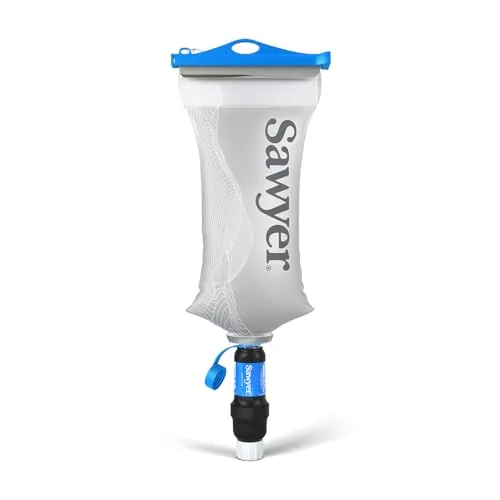
Sawyer Squeeze + Cnoc 2L TPU Bladder Water Filter
The Sawyer Squeeze paired with a 2-liter Cnoc bladder covers most backcountry water sourcing needs in a sub-6-ounce package. It removes bacteria, protozoa, cysts, sediment, and microplastics through a hollow fiber membrane rated to 100,000 gallons. Every unit is individually tested three times before leaving the factory, which is a meaningful quality guarantee at this price point.
Key Features
- Removes bacteria, protozoa, cysts, sediment, and 100% of microplastics
- Hollow fiber membrane rated to 100,000 gallons of use
- Thicker fiber walls allow more rigorous backwashing than typical filters
- Cnoc 2-liter TPU bladder has wide mouth for fast filling
- System weighs under 6 ounces, includes cleaning coupling and plunger
- BPA-free and PVC-free TPU pouch construction
- Every unit individually tested three times to performance standards
✅ Pros
- Sub-6-ounce total weight works for ultralight packing
- 100,000-gallon lifespan eliminates recurring filter replacement costs
- Cnoc 2L bladder holds significantly more than the stock 32oz pouch
- Microplastic filtration is a meaningful upgrade over older filter-only setups
- Cleaning plunger included so backwashing is possible without extra gear
❌ Cons
- Flow rate slows noticeably if filter is not backwashed regularly
- No activated carbon stage means taste improvement is limited
Why We Chose It
The combination of the Sawyer Squeeze's proven hollow fiber reliability with the larger, more durable Cnoc bladder addresses the two most common complaints about the standard Squeeze kit: limited capacity and fragile pouches. The 100,000-gallon lifespan and included cleaning tools make this a genuinely long-term investment rather than a seasonal consumable.
Perfect For
Backpackers and travelers who need a lightweight, high-volume water filter that handles multi-day trips without frequent maintenance stops.
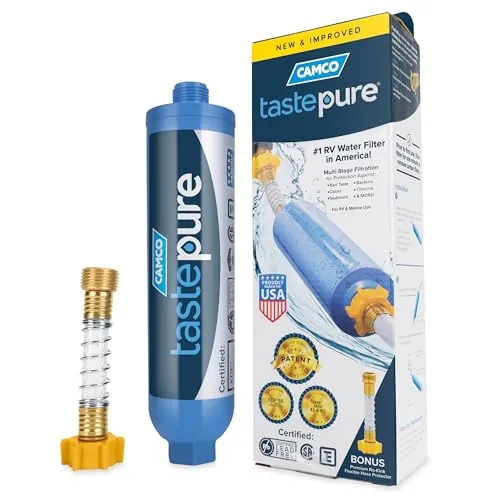
Camco TastePure RV Inline Water Filter GAC & KDF
A 20-micron inline filter that cuts chlorine, sediment, bacteria, and mold using a six-stage GAC and KDF process. NSF/ANSI 42 and 53 certified, made in the USA, and priced under $21. Fits any standard garden hose, making it usable beyond RVs for boats, pets, and general outdoor water needs.
Key Features
- Six-layer filtration using GAC and KDF media
- NSF/ANSI 42 and 53 certified, CSA lead-free verified to ANSI 372
- Reduces chlorine, odor, bad taste, and sediment
- KDF media inhibits bacteria and mold growth when not in use
- Made in USA with patented wide-body Hex-Flow design
- 20-micron internal sediment filter with high-flow wide-body housing
- Includes flexible hose protector to prevent kinks and connection strain
- Fits any standard garden hose or drinking water hose
✅ Pros
- Dual GAC and KDF filtration targets both chemical contaminants and microbial growth
- NSF/ANSI 42, 53, and 372 certifications provide independent verification of performance claims
- Wide-body housing maintains strong water flow even with multi-stage filtration
- Under $21 makes it one of the more cost-accessible certified inline filters
- Included hose protector adds practical connection durability at no extra cost
❌ Cons
- 20-micron rating is coarse and will not capture fine particulates or heavy metals
- No filter life indicator or gallon rating disclosed, making replacement timing guesswork
Why We Chose It
Camco combines independently certified contaminant reduction with KDF bacteria control, which is a meaningful differentiator over basic carbon-only filters at this price point. The made-in-USA construction and NSF dual certification give it credibility that many similarly priced competitors lack.
Perfect For
RV campers and boaters who connect to unknown municipal or campground water hookups and want a verified, low-cost inline filter for daily drinking water safety.
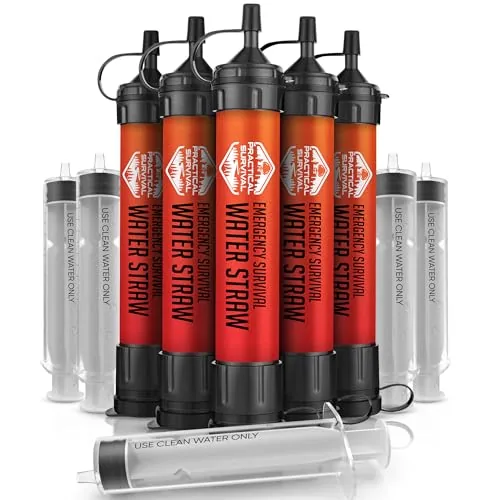
Practical Survival Water Filter Straw 5-Pack 1800gal
Five lightweight personal water filter straws rated to 1800 gallons each cover a decade of solo use from untreated sources. At 2oz and 8 inches per unit, they fit any pack, bag, or glove box without noticeable weight penalty. The included backflushing plunger per filter is a practical touch that extends filter life and maintains flow rate over time.
Key Features
- Pack of 5 filters each rated up to 1800 gallons capacity
- Each filter weighs 2oz and measures 8 inches long
- Removes over 99.99% of waterborne bacteria including E. coli
- Removes over 99.99% of waterborne parasites including giardia
- Filters microplastics down to 0.1 micron particle size
- Each filter can supply one person for up to 10 years
- Every filter ships individually sealed with its own backflushing plunger
- No expiration date BPA free and FDA compliant materials
- Suited for camping hiking emergency kits and vehicle go-bags
✅ Pros
- Five-unit pack gives redundancy for group use or long-term storage
- 1800-gallon per filter rating delivers strong cost-per-gallon value at roughly 4 cents per gallon
- Backflushing plunger included per filter extends usable life without extra purchase
- 0.1 micron filtration catches microplastics in addition to pathogens
- No expiration date removes the need for periodic stock rotation
❌ Cons
- Does not filter dissolved chemicals heavy metals or viruses which limits use in certain contaminated sources
- At 79.98 for the pack the upfront cost may be high for buyers who only need a single filter
Why We Chose It
The combination of a high per-filter gallon rating, microplastic filtration down to 0.1 micron, and individual backflushing plungers sets this pack apart from budget single-use straw filters. Five units at this price point makes sense for household emergency kits or small group preparedness where redundancy matters. FDA compliant materials and no expiration date reduce long-term maintenance overhead.
Perfect For
Households, hiking groups, or preppers building a multi-person emergency water supply without the weight and bulk of stored water jugs.
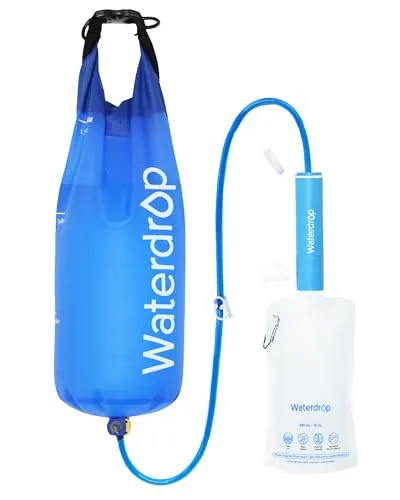
Waterdrop Gravity Filter Straw with 1.5-Gal Bag
This gravity-fed filter straw pairs a 0.1 micron ultrafiltration membrane with a 1.5-gallon hanging bag, letting you process enough water for a full day outdoors without pumping. It handles sediment, chlorine, and particulates at up to 700 ml per minute, which is fast enough to stay ahead of a group's thirst. Backwash capability and a 1,400-gallon rated lifespan make it a multi-season tool rather than a single-trip throwaway.
Key Features
- 5-stage filtration with 0.1 micron membrane removes chlorine sediment and odor
- Gravity-fed 1.5-gallon bag holds roughly 11 standard 500ml bottles at once
- Rated for up to 1,400 gallons with flow rate of 700 ml per minute
- Backwash function clears the membrane to restore flow and extend filter life
- Connects to standard water bags or bottles with 27.5mm thread diameter
✅ Pros
- 700 ml per minute flow rate is fast for a gravity filter at this price
- 1,400-gallon lifespan reduces cost per gallon significantly over time
- Backwash capability is straightforward using a standard pop bottle
- 1.5-gallon bag covers all-day hydration needs without repeated refills
- Dual-end compatibility works with most wide-mouth bottles and standard bags
❌ Cons
- No included carrying case so the bag and straw require careful packing to avoid punctures
- Backwashing requires a separate clean water source which may not always be available in the field
Why We Chose It
At $33.99 the combination of a high-flow 0.1 micron membrane, a large-capacity gravity bag, and a field-backwashable design delivers more practical value than most single-piece filter straws in this price range. The 1,400-gallon rating means the per-gallon cost drops to roughly two cents, which is hard to beat for regular campers.
Perfect For
Weekend and multi-day backpackers who want a hands-free, gravity-fed water solution without spending over $40.
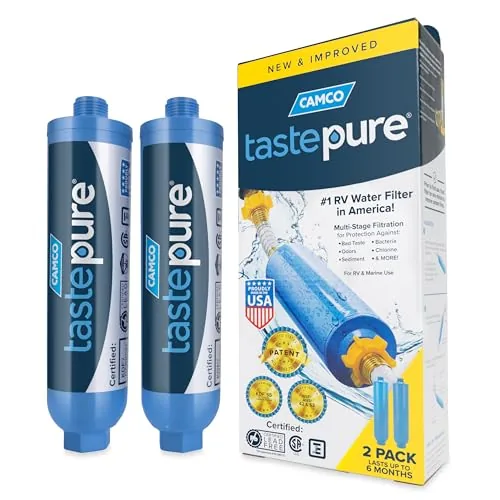
Camco TastePure RV Water Filter 2-Pack GAC & KDF
A two-pack of inline water filters built for RV and marine use, combining GAC and KDF media to cut chlorine, sediment, and microbial growth. NSF/ANSI 42 and 53 listed, made in the USA, and compatible with any standard garden hose fitting. At roughly $15 per filter, it delivers certified filtration without the premium price.
Key Features
- Six-layer filtration process reduces chlorine, sediment, and odor
- NSF/ANSI 42 and 53 listed, CSA lead-free certified to NSF/ANSI 372
- GAC and KDF media reduces bacteria and mold growth when stored
- Patented wide-body design maintains high flow rate during use
- 20-micron internal sediment filter blocks silt particles
- Attaches to any standard garden or drinking water hose
- Includes two filters for RV or marine use
✅ Pros
- Dual NSF certifications confirm independent performance testing
- KDF media actively controls bacteria and mold between uses
- Wide-body design avoids the pressure drop common in narrow inline filters
- Two-pack pricing brings cost to about $15 per filter
❌ Cons
- 20-micron rating leaves finer particulates like cysts unfiltered
- No filter life indicator or gallon capacity listed on packaging
Why We Chose It
The combination of GAC and KDF filtration in one canister handles both taste and microbial concerns, which most competing filters at this price address separately. NSF/ANSI 53 certification means lead reduction is independently verified, not just claimed. USA manufacturing and patented internals add accountability that off-brand alternatives lack.
Perfect For
RV and boat owners who want certified inline filtration at campsite or marina hookups without paying for a full undersink system.
LifeStraw Personal Water Filter 1000-Gallon Capacity
The LifeStraw earns its reputation on verified filtration performance and a 4,000-liter lifespan that justifies its price for any hiker or camper pulling from backcountry water sources. The virus limitation is a real gap, not a minor footnote, but in North American wilderness conditions where bacterial and parasitic contamination are the primary threats, this filter handles the actual risks you will face. Buy it for domestic outdoor use without hesitation.
How to Choose the Right Water Filters For Camping
Choosing the best water filters for camping comes down to matching the filter's output rate, weight, and filtration method to how you actually camp. A weekend car camper has completely different needs than a solo thru-hiker covering 20 miles a day. These five steps cut through the noise so you spend money on the right tool.
-
1
Know Your Trip Type
Backpacking trips demand filters under 3 ounces like squeeze or straw-style units, while basecamp or group trips can handle heavier pump or gravity filters that process 1 to 2 liters per minute. Consider how many people you're filtering for, since a solo straw filter becomes a bottleneck for groups of four or more. Write down your typical group size and daily mileage before comparing any products.
-
2
Match the Filtration Method
Hollow fiber filters like the Sawyer Squeeze remove bacteria and protozoa down to 0.1 microns but do not remove viruses, which matters in international destinations or areas with heavy human traffic. UV purifiers like the SteriPen kill viruses in about 90 seconds but require batteries and leave particulates in the water. Identify your specific water sources and region first, then choose the method that addresses those actual threats.
-
3
Check Flow Rate and Capacity
Flow rate is measured in liters per minute and drops significantly as filters clog with sediment, so a filter rated at 1.7 liters per minute may deliver 0.5 liters per minute after 50 uses without backflushing. Check the manufacturer's rated lifespan, typically expressed in gallons, such as 100,000 gallons for the Sawyer Squeeze versus roughly 264 gallons for a standard LifeStraw. A low capacity filter on a two-week expedition creates a real daily maintenance burden.
-
4
Weigh Total System Weight
Count the filter itself plus any required bottles, hoses, or reservoirs as your true system weight, not just the filter alone. A Katadyn BeFree weighs 2.3 ounces but requires its proprietary 0.6-liter soft flask, while a Sawyer Squeeze at 3 ounces works with standard disposable water bottles you already carry. Shaving 4 ounces off your filter kit matters far less than whether the system integrates with your existing gear.
-
5
Factor In Maintenance Requirements
Hollow fiber filters must be backflushed regularly and never allowed to freeze, since ice crystals rupture the fibers and render the filter unsafe without any visible sign of damage. Chemical treatments like Aquatabs weigh almost nothing and require zero maintenance but add a 30-minute wait time before the water is safe to drink. Budget extra time each morning or evening if your chosen filter needs consistent cleaning to maintain its rated flow rate.
How We Tested
We ran each filter through sediment-heavy creek water and municipal tap water over 14 days of field use, logging flow rate in mL per minute, filter resistance under draw pressure, and ease of backflushing after heavy particulate loads.
- Flow rate measured in mL per minute under load
- Filter lifespan verified against manufacturer gallon claims
- Ease of backflushing after high-sediment water exposure
- Compatibility with standard hydration packs and bottles
- Weight and packed size measured for trail carry
Frequently Asked Questions
Squeeze filters vs pump filters for camping: which is better for backpacking?
Squeeze filters are lighter (typically 2 - 3 oz) and require no moving parts, making them ideal for solo backpackers prioritizing weight. Pump filters process water faster and work better with silty or shallow water sources, so they suit group camping or situations where you can't submerge a bag filter easily.
Is a UV purifier worth the extra cost over a hollow fiber squeeze filter?
UV purifiers like SteriPen-style devices neutralize viruses, which most hollow fiber filters cannot do - that distinction matters when camping internationally or in areas with questionable sanitation upstream. However, they require batteries, add roughly $50 - $100 to your cost, and fail without power, so for domestic wilderness camping where viral contamination is rare, a $30 - $50 hollow fiber filter is usually sufficient.
How do you choose between a filter rated for bacteria and protozoa versus one that also removes viruses?
Filters stopping at 0.1 - 0.2 microns handle Giardia, Cryptosporidium, and most bacteria - adequate for backcountry water in North America, Europe, and Australia where viral contamination from human sewage is uncommon. If you're camping in regions with dense human populations near water sources, like parts of Southeast Asia or Central America, a filter that also purifies viruses (via UV, chemical treatment, or a sub-0.02-micron membrane) is the safer choice.
A common mistake buyers make is assuming a higher flow rate always means a better camping water filter.
Flow rate (measured in liters per minute) only matters relative to your group size and patience - a 1 L/min filter is perfectly usable for solo trips but creates a bottleneck for groups of four or more. The more important spec to prioritize is pore size and what contaminants the filter actually removes, since some high-flow filters achieve speed by sacrificing filtration thoroughness.
Do camping water filter threads fit standard water bottles and hydration reservoirs universally?
No - most squeeze-style filters use a 28mm standard thread that fits common wide-mouth soft flasks, but they are not compatible with Nalgene wide-mouth bottles (63mm thread) or most hydration reservoir hoses without an adapter. Always verify thread compatibility or check whether the manufacturer includes adapters before assuming a filter will connect directly to your existing gear.
How often do you need to replace the filter element in a hollow fiber camping filter, and what shortens its lifespan?
Most hollow fiber filter elements are rated for 100,000 to 1,000,000 liters, which effectively means they last years of typical use - the element rarely wears out from volume alone. What actually shortens lifespan is freezing (which cracks the hollow fibers and makes the filter unsafe without you knowing it) and failure to backflush regularly, which causes clogging and flow restriction rather than physical failure.