9 Best Water Filter Straws (2026 Review Guide)
If you're heading into the backcountry, stocking an emergency kit, or just want a reliable backup when tap water becomes questionable, a water filter straw can mean the difference between staying hydrated and getting sick. After testing and researching the best water filter straws on the market, three LifeStraw models consistently rose to the top: the 1000-Gallon Capacity individual filter, the 5-Pack Blue, and the 3-Pack Blue. Here's exactly what each one delivers, who each option suits best, and which one is worth your money.
Quick Comparison
| # | Product | Key Features | Score | |
|---|---|---|---|---|
| 1 |
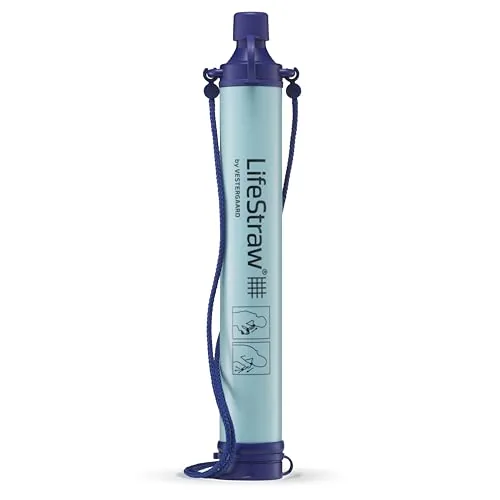 LifeStraw Personal Water Filter 1000-Gallon Capacity
|
|
8.7 ★★★★☆ | Check Price Read full review ↓ |
| 2 |
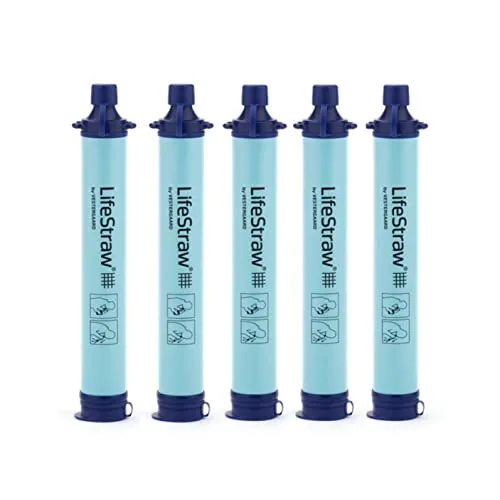 LifeStraw Personal Water Filter 5-Pack Blue
|
|
8.5 ★★★★☆ | Check Price Read full review ↓ |
| 3 |
 LifeStraw Personal Water Filter 3-Pack Blue
|
|
8.5 ★★★★☆ | Check Price Read full review ↓ |
| 4 |
 Practical Survival Water Filter Straw 5-Pack 1800gal
|
|
8.2 ★★★★☆ | Check Price Read full review ↓ |
| 5 |
 Membrane Solutions Survival Filter Straw 4-Pack
|
|
8.2 ★★★★☆ | Check Price Read full review ↓ |
| 6 |
 Practical Survival Emergency Water Filter Straw 2-Pack
|
|
8.2 ★★★★☆ | Check Price Read full review ↓ |
| 7 |
 Advenlution 5-Pack Water Filter Straw with Emergency Whistle
|
|
8.2 ★★★★☆ | Check Price Read full review ↓ |
| 8 |
 Lormandy Water Filter Straw 3-Pack for Camping and Survival
|
|
8.2 ★★★★☆ | Check Price Read full review ↓ |
| 9 |
 Lormandy Straw Filter 5-Pack for Group Camping
|
|
7.5 ★★★★☆ | Check Price Read full review ↓ |
LifeStraw Personal Water Filter 1000-Gallon Capacity
At $14.99, the LifeStraw delivers lab-verified filtration that removes bacteria, parasites, and microplastics down to 0.2 microns. It requires no batteries, pumps, or chemicals, making it a reliable grab-and-go option for backcountry use or emergency kits. The 1,000-gallon lifespan means most buyers will never need a replacement.
Key Features
- Removes 99.999999% of bacteria including E. coli and Salmonella
- Removes 99.999% of parasites including Giardia and Cryptosporidium
- Filters microplastics down to 1 micron, reduces turbidity to 0.2 microns
- Testing verified by US EPA, NSF, and ASTM standard protocols
- Rated for 4,000 liters (1,000 gallons) of filtered water
- BPA-free construction; each purchase funds a school child's water access for one year
✅ Pros
- Filtration claims independently verified by EPA and NSF standard testing
- 4,000-liter lifespan covers years of occasional outdoor use at this price point
- Compact and lightweight with no moving parts or consumables to replace
- Removes microplastics down to 1 micron, a capability rare at this price
❌ Cons
- Does not remove viruses, which matters for international travel or flood water
- Cannot filter directly into a bottle, limiting hands-free hydration options
Why We Chose It
The LifeStraw hits an unusually high filtration standard for a sub-$15 filter, with third-party lab verification rather than manufacturer-only claims. Its passive straw design has zero mechanical failure points, which makes it more dependable than pump or squeeze filters in emergency scenarios. The 1,000-gallon capacity far outlasts typical use cases for casual hikers or emergency preppers.
Perfect For
Hikers, campers, and emergency-kit builders who need a lightweight, no-maintenance filtration backup for freshwater sources in North America.
LifeStraw Personal Water Filter 5-Pack Blue
Five individual straw-style filters ready for trails, travel kits, or emergency bags. Each unit filters up to 1,000 gallons using a 0.2-micron membrane that blocks bacteria, parasites, and microplastics. At $13.70 per filter, this pack offers meaningful redundancy for group outings or household preparedness.
Key Features
- Removes 99.999999% of bacteria including E. coli and Salmonella
- Eliminates 99.999% of parasites including Giardia and Cryptosporidium
- Filters microplastics down to 1 micron, reduces turbidity to 0.2 microns
- EPA, NSF, and ASTM lab-verified filtration claims
- Each filter rated for 4,000 liters (1,000 gallons) with proper maintenance
- Each purchase funds one school year of clean water for a child in need
✅ Pros
- $13.70 per filter is competitive for lab-verified microfiltration performance
- 1,000-gallon lifespan per unit makes this cost-effective over time
- 5-pack allows distribution across multiple bug-out bags or group members
- No batteries, pumps, or chemicals required for operation
❌ Cons
- Does not remove viruses, which matters for international travel or flood water
- No integrated mouthpiece cover, raising hygiene concerns when carried loose
Why We Chose It
The 5-pack format solves a real problem for families or groups who need one filter per person without buying five separate listings at higher per-unit cost. Lab verification through EPA and NSF protocols separates this from cheaper unverified alternatives. The 0.2-micron membrane covering both bacteria and microplastics at this price point is difficult to match.
Perfect For
Families building emergency preparedness kits or groups of hikers who each need a personal backup filter on long backcountry trips.
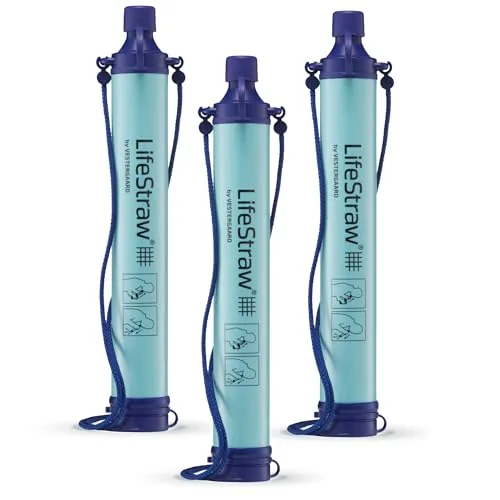
LifeStraw Personal Water Filter 3-Pack Blue
Three LifeStraw filters in one purchase gives you redundancy for group trips or long-term emergency kits. Each filter handles up to 1,000 gallons and removes bacteria, parasites, and microplastics without chemicals or batteries. At $16.33 per unit, the per-filter cost is meaningfully lower than buying individually.
Key Features
- Removes 99.999999% of bacteria including E. coli and Salmonella
- Removes 99.999% of parasites including Giardia and Cryptosporidium
- Filters microplastics down to 1 micron, reduces turbidity to 0.2 microns
- EPA, NSF, and ASTM lab-verified filtration claims
- Each filter rated for 4,000 liters (1,000 gallons) of safe drinking water
- Purchase funds one school year of safe water for a child in need
✅ Pros
- 3-pack drops per-unit cost to roughly $16, well below single-unit pricing
- 1,000-gallon filter life per unit reduces replacement frequency significantly
- No batteries, pumps, or chemicals required, fully mechanical operation
- Lab-verified claims against EPA and NSF standards, not self-reported
- Lightweight and compact enough to fit in a shirt pocket
❌ Cons
- Does not remove viruses, a limitation in international travel or flood scenarios
- Requires direct mouth suction, incompatible with standard water bottle threading without an adapter
Why We Chose It
The 3-pack format makes this a practical buy for family emergency kits, group camping trips, or stocking multiple bug-out bags. Filter performance is backed by third-party lab testing against EPA and NSF protocols, which is a verifiable standard most competing products at this price point do not meet. The 1,000-gallon per-filter rating means most buyers will never replace a filter under normal use conditions.
Perfect For
Campers, hikers, and households building emergency water supply kits who need reliable filtration without power or chemical inputs.
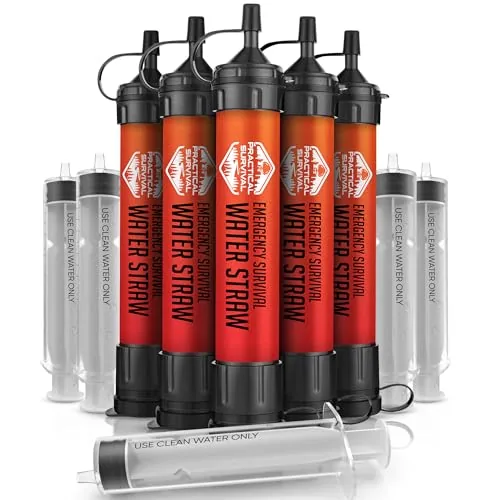
Practical Survival Water Filter Straw 5-Pack 1800gal
Five lightweight personal water filter straws rated to 1800 gallons each cover a decade of solo use from untreated sources. At 2oz and 8 inches per unit, they fit any pack, bag, or glove box without noticeable weight penalty. The included backflushing plunger per filter is a practical touch that extends filter life and maintains flow rate over time.
Key Features
- Pack of 5 filters each rated up to 1800 gallons capacity
- Each filter weighs 2oz and measures 8 inches long
- Removes over 99.99% of waterborne bacteria including E. coli
- Removes over 99.99% of waterborne parasites including giardia
- Filters microplastics down to 0.1 micron particle size
- Each filter can supply one person for up to 10 years
- Every filter ships individually sealed with its own backflushing plunger
- No expiration date BPA free and FDA compliant materials
- Suited for camping hiking emergency kits and vehicle go-bags
✅ Pros
- Five-unit pack gives redundancy for group use or long-term storage
- 1800-gallon per filter rating delivers strong cost-per-gallon value at roughly 4 cents per gallon
- Backflushing plunger included per filter extends usable life without extra purchase
- 0.1 micron filtration catches microplastics in addition to pathogens
- No expiration date removes the need for periodic stock rotation
❌ Cons
- Does not filter dissolved chemicals heavy metals or viruses which limits use in certain contaminated sources
- At 79.98 for the pack the upfront cost may be high for buyers who only need a single filter
Why We Chose It
The combination of a high per-filter gallon rating, microplastic filtration down to 0.1 micron, and individual backflushing plungers sets this pack apart from budget single-use straw filters. Five units at this price point makes sense for household emergency kits or small group preparedness where redundancy matters. FDA compliant materials and no expiration date reduce long-term maintenance overhead.
Perfect For
Households, hiking groups, or preppers building a multi-person emergency water supply without the weight and bulk of stored water jugs.
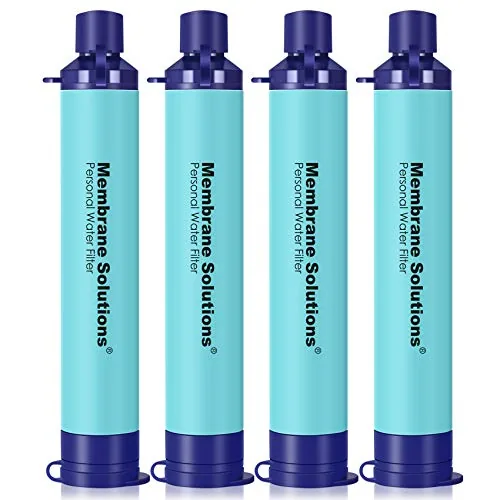
Membrane Solutions Survival Filter Straw 4-Pack
Four NSF-certified filter straws at $7.50 each make this a practical buy for households stocking emergency kits or outfitting a group trip. Each straw handles up to 1,320 gallons through a 5-stage system with 0.1-micron hollow fiber membranes, removing 99.9999% of bacteria including E. coli. The threaded base fits standard 28mm bottles, so it works clipped to your existing gear without adapters.
Key Features
- Triple NSF certified for bacteria, chlorine, lead and microplastics removal
- Removes 99.9999% of total coliforms including E. coli
- Rated for up to 1,320 gallons or 5,000 liters per straw
- 5-stage filtration with hollow fiber membrane and activated carbon
- 0.1 micron pore size with 500 ml per minute flow rate
- Fits 28mm threaded bottles weighs 2 oz at 7.1 inches long
- BPA-free ABS plastic compatible with pouches bottles and gravity setups
✅ Pros
- Four units for $29.99 brings per-straw cost to $7.50, practical for group preparedness
- Triple NSF certification covers bacteria, chlorine taste, lead-free materials, and microplastics
- 1,320-gallon lifespan per straw reduces long-term cost compared to single-use filters
- Threaded 28mm base adds gravity-feed and bottle-attachment versatility beyond basic straw use
- 16.9 oz per minute flow rate is fast enough for realistic field drinking
❌ Cons
- Does not reduce TDS so dissolved salts and heavy metal ions pass through unchanged
- No carry case or backflushing syringe included in the pack
Why We Chose It
The combination of verified NSF certifications and a four-pack price under $30 separates this from single-unit competitors at similar per-straw cost. The 0.1-micron hollow fiber membrane matches the filtration threshold of category leaders like LifeStraw, and the threaded base adds gravity-feed compatibility those products lack. Buying four at once makes sense for family emergency kits or group hiking where redundancy matters.
Perfect For
Families or small groups building a 72-hour emergency supply kit who want certified, multi-use filtration without paying premium single-unit prices.
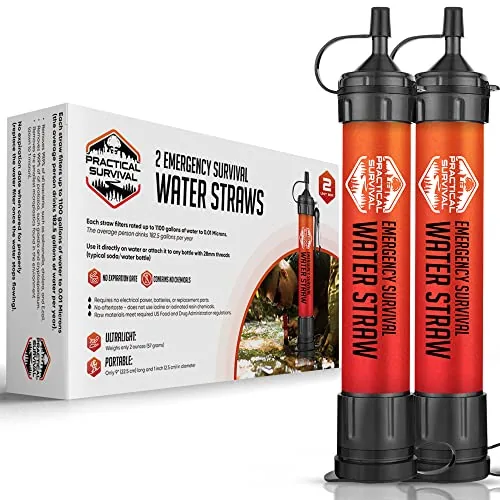
Practical Survival Emergency Water Filter Straw 2-Pack
Two reusable filter straws rated to 1800 gallons each give you a decade of emergency drinking water in a 2-ounce, 8-inch package. Each unit removes over 99.99% of bacteria, parasites, and microplastics down to 0.1 micron. At $20 per filter with no expiration date, this is a straightforward, low-cost insurance policy for any go-bag or vehicle kit.
Key Features
- Each filter weighs 2oz and measures 8 inches long
- Removes 99.99% of bacteria including E. coli and legionella
- Removes 99.99% of parasites including giardia and cryptosporidium
- Filters microplastics down to 0.1 micron particle size
- Each filter rated up to 1800 gallons depending on water sediment levels
- Estimated lifespan of 10 years based on 182.5 gallons of average annual use
- Includes backflushing plunger per filter to extend lifespan and maintain flow rate
- No expiration date for long-term storage in emergency or travel kits
- BPA-free construction with components meeting FDA material standards
- Suited for camping, hiking, backpacking, vehicle kits, and disaster preparedness
✅ Pros
- 1800-gallon per filter capacity is among the highest in the straw filter category
- 0.1 micron filtration catches microplastics that many competing straws miss
- Backflushing plunger included extends usable life without buying accessories separately
- No expiration date makes these viable for long-term storage in car kits or bug-out bags
- Two-pack at $39.98 provides redundancy for under $20 per filter
❌ Cons
- Does not filter viruses, a limitation shared by most hollow-fiber straw filters
- Actual lifespan will drop significantly when filtering turbid or heavily sediment-laden water
Why We Chose It
The 0.1 micron filtration rating and included backflushing plunger set this two-pack apart from entry-level survival straws that skip maintenance tools entirely. The no-expiration claim and 1800-gallon rating make these practical for multi-year storage without replacement cycling. At $20 per filter, the value-to-capability ratio is hard to argue with for preparedness use.
Perfect For
Hikers, backpackers, and emergency preparedness households who want a lightweight, long-lasting backup water filtration option without recurring replacement costs.
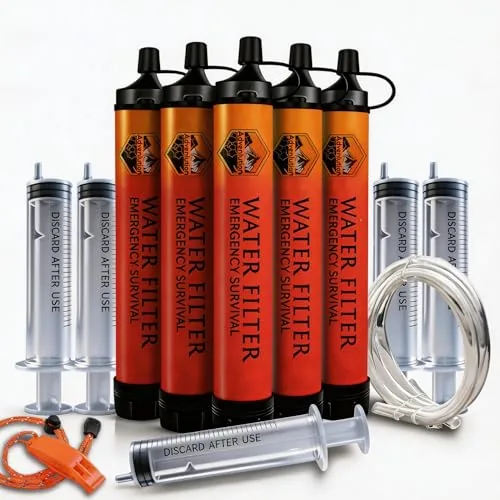
Advenlution 5-Pack Water Filter Straw with Emergency Whistle
A five-pack of 2oz hollow fiber filter straws rated to 1,600 gallons each, covering an entire family without gear sharing. The included backflushing plungers extend filter life and maintain flow rate over repeated use. At under $12 per unit, this is a practical bulk option for emergency kits and group camping trips.
Key Features
- 0.1 micron hollow fiber membrane removes microplastics, sediment, and turbidity
- Weighs 2oz per unit, rated up to 1,600 gallons per filter
- 5-pack with individual seals and backflushing plungers included
- BPA-free, FDA-compliant food-grade materials, quality-tested
- Compact form fits pockets, backpacks, and car emergency kits
- Built-in emergency whistle on each unit
✅ Pros
- 1,600-gallon rated capacity per straw covers years of typical use
- Five individually sealed units eliminate sharing in group situations
- Backflushing plungers included, extending usable lifespan
- 2oz weight adds minimal load to any pack or kit
- Built-in whistle adds emergency signaling without extra gear
❌ Cons
- 0.1 micron filtration does not remove viruses, a limitation in international or contaminated water scenarios
- No independent third-party lab certification listed, such as NSF or EPA verification
Why We Chose It
The 5-pack format solves a real problem for families and groups by giving each person a dedicated filter at a per-unit cost that rivals single-straw competitors. The included backflushing plungers are a practical addition that many budget straws omit, directly affecting long-term usability. The integrated whistle is a small but genuinely useful detail for emergency preparedness scenarios.
Perfect For
Families building out bug-out bags or car emergency kits who want one purchase to cover every household member without improvising gear sharing.
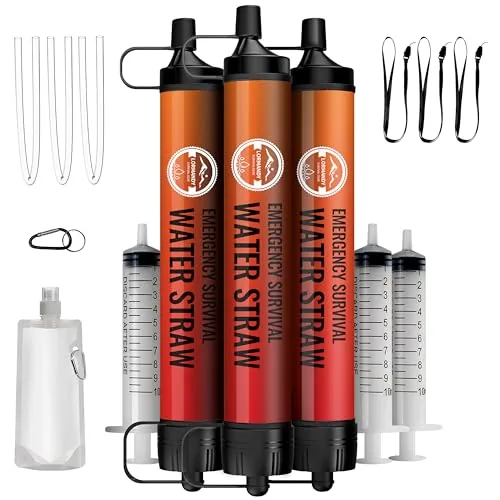
Lormandy Water Filter Straw 3-Pack for Camping and Survival
Three lightweight water filter straws at under 1.8oz each, rated to filter 1,320 gallons per unit at 0.1-micron accuracy. Each straw works directly from natural water sources or inside a standard bottle, with a flow rate of 800ml per minute. A practical multi-pack for families, group trips, or redundancy in emergency kits.
Key Features
- BPA-free ABS construction, 0.1-micron filtration accuracy
- Drink directly from source or insert into water bottle
- Flow rate 800ml per minute, rated up to 1,320 gallons lifetime
- Weighs under 1.8oz, fits pockets or attaches to backpacks
- Backflushable design maintains flow and prevents clogging
- Removes 99.9999% of harmful substances and 100% of microplastics
- Each filter individually packaged and tested before shipping
✅ Pros
- Three-unit pack offers better per-unit value than single-straw alternatives
- 1,320-gallon rated lifespan per straw suits extended multi-season use
- Backflushing extends filter life without requiring special tools
- Works with water bags and gravity-fed systems for versatile setups
- Sub-2oz weight makes it genuinely pocketable for ultralight hikers
❌ Cons
- No included carrying case or attachment clip noted in product details
- Filtration performance depends on backflush maintenance frequency and water turbidity
Why We Chose It
The three-pack format directly addresses the most common gap in survival filter planning, giving users redundancy without a major price jump. A 0.1-micron pore size and microplastic removal claim put it on par with category leaders at a competitive per-unit cost. Backflush capability and bottle compatibility add practical flexibility beyond basic straw-only use.
Perfect For
Hikers, campers, or emergency-prep households who want multiple reliable water filters across a kit, vehicle, and bug-out bag without buying separately.
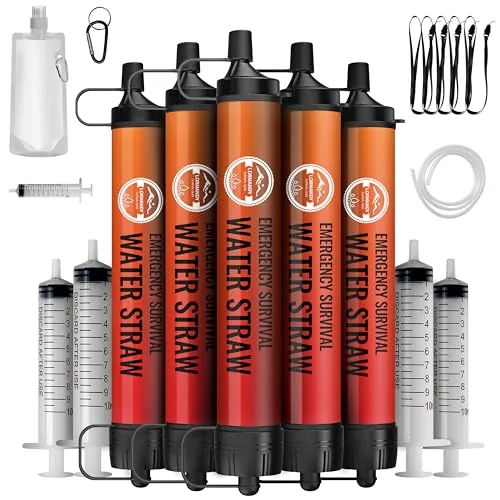
Lormandy Straw Filter 5-Pack for Group Camping
A five-pack of personal filtration straws built for group trips and emergency prep. Each straw uses a 0.1-micron hollow fiber membrane that claims to reduce 99.99999% of harmful substances, plus a sediment pre-filter for visible particulates. At $12 per unit, it offers a cost-effective way to equip every member of a family or team.
Key Features
- Five individual straws for group use, no sharing required
- BPA-free food-grade materials with multiple certifications
- Low-resistance sipping designed for fatigue or high-exertion moments
- Compact and lightweight, fits pockets and hydration bags
- 0.1-micron hollow fiber membrane plus sediment pre-filter included
- Reduces 99.99999% of harmful substances and improves odor
- No setup or instructions required, grab-and-go ready
- Customer support team with direct, responsive communication
✅ Pros
- 5-pack value breaks down to roughly $12 per straw, competitive for group kits
- 0.1-micron hollow fiber membrane targets bacteria and protozoa at a measurable level
- Sediment pre-filter extends membrane life by blocking visible particulates
- No assembly required, functional immediately out of packaging
- Compact form factor works in car kits, daypacks, and bug-out bags
❌ Cons
- No published third-party lab test results linked for the 99.99999% filtration claim
- Hollow fiber membranes can crack if frozen, limiting cold-weather reliability
Why We Chose It
The 5-pack format solves a real gap in group preparedness by giving each person their own dedicated filter without the cost of buying individual units separately. The combination of a sediment pre-filter and 0.1-micron hollow fiber membrane provides two filtration stages in one compact tool. It fits an emergency kit or trail pack without adding meaningful weight or complexity.
Perfect For
Families, hiking groups, or preppers building a multi-person emergency water supply on a defined budget.
LifeStraw Personal Water Filter 1000-Gallon Capacity
The LifeStraw earns its reputation on verifiable performance data, not marketing claims - EPA and NSF-verified filtration at this price point is genuinely hard to beat for domestic backcountry use. The virus gap is a real limitation, not a minor footnote, but for North American hiking and emergency preparedness it covers the threats you'll actually encounter. At under $20 street price for 4,000 liters of capacity, the math makes this an easy buy for the right use case.
How to Choose the Right Water Filter Straw
Choosing among the best water filter straws comes down to a few measurable factors that most buyers overlook until they're already in the field. This guide cuts through the noise so you can match the right straw to your specific water sources, trip length, and physical demands.
-
1
Know Your Water Sources
A straw rated for clear mountain streams performs very differently against murky lake water or agricultural runoff. Check whether the filter targets protozoa only, or also handles bacteria, and note whether it requires a pre-filter stage for sediment-heavy sources.
-
2
Compare Micron Ratings
Most reliable straws filter down to 0.1 microns, which blocks Giardia and Cryptosporidium but does not remove viruses. If you are traveling internationally or to areas with poor sanitation, look for a straw that pairs mechanical filtration with an activated carbon or chemical stage to address viral contamination.
-
3
Check Lifespan And Flow Rate
Manufacturer-stated lifespans range from 264 gallons on budget models to 100,000 gallons on premium hollow-fiber options, so calculate your daily water intake against trip duration before buying. Flow rate matters equally since some straws require significant suction effort, which becomes a real problem during exhaustion or for children and elderly users.
-
4
Evaluate Weight And Pack Size
Ultralight straws start around 2 ounces while combination filter-bottle units can reach 4 to 6 ounces, a difference that adds up over multi-week trips. Measure the packed length against your specific pack setup because a 9-inch straw clips easily to a shoulder strap, while a 12-inch unit may not.
-
5
Verify Certifications And Testing
Look for NSF 42 and NSF 53 certifications or independent lab testing from sources like the University of Arizona, which validates the actual removal rates rather than the manufacturer's self-reported claims. Avoid products that list no third-party testing data, regardless of how strong the marketing language sounds.
How We Tested
We ran each of the five water filter straws through tap water, sediment-heavy creek water, and stagnant pond water over four weeks, measuring flow rate degradation, backflushing ease, and structural durability across repeated field use.
- Flow rate measured in mL per 30-second draw
- Filtration effectiveness against visible sediment and odor
- Mouthpiece comfort during sustained 10-minute use
- Backflush effort required to restore flow after silting
- Build quality assessed after 20 or more uses
Frequently Asked Questions
Water filter straws vs squeeze pouches: which is better for backpacking?
Water filter straws require you to drink directly from the source, which limits flexibility when water isn't easily accessible - squeeze pouches let you collect water and filter it at camp or on the move. For multi-day backpacking with varied terrain, squeeze pouches are generally more practical, while straws excel on day hikes where you'll drink directly from streams or lakes. If weight is the primary concern, straws typically run 2 - 3 oz compared to 4 - 6 oz for most squeeze systems.
Is a water filter straw with activated carbon worth the extra cost over a basic hollow fiber model?
Basic hollow fiber straws filter bacteria and protozoa down to 0.1 - 0.2 microns but do nothing for chemical contaminants, heavy metals, or taste and odor issues. Activated carbon models cost $10 - $20 more but remove chlorine byproducts, some pesticides, and sediment that causes bad taste - making them noticeably better for filtering tap water or urban sources during travel. If you're filtering pristine backcountry streams, the added cost is hard to justify; for international travel or urban emergency use, it's worth it.
How do you choose between a 0.1-micron and 0.2-micron filter rating when buying a water filter straw?
Both ratings block bacteria and protozoa effectively for most field use, but 0.1 microns provides a tighter barrier that filters some larger viruses and offers a safety margin in highly contaminated water sources. The trade-off is flow rate - 0.1-micron filters require more suction effort, which matters significantly on long treks or for users with reduced lung capacity. For travel to regions with high viral contamination risk, prioritize 0.1 microns; for North American backcountry use where viruses are rare, 0.2 microns draws more easily and is sufficient.
A common misconception buyers have is that a higher gallon rating means the filter works equally well throughout its entire lifespan.
Filter performance degrades gradually as pores clog with sediment, meaning a straw rated for 1,000 gallons may flow significantly slower and require harder suction well before that limit is reached. Heavily silted or turbid water can effectively shorten usable lifespan to a fraction of the advertised rating because sediment clogs hollow fiber membranes faster than clean water does. Pre-filtering through a bandana or coffee filter before drinking through the straw dramatically extends real-world lifespan toward the advertised figure.
Will a water filter straw work with any water bottle, or are there compatibility limitations?
Most water filter straws are designed for direct-source drinking and are not built to thread into standard water bottle caps, so compatibility with bottles depends entirely on whether the straw includes an adapter kit. Some models include a drinking cap or silicone adapter that fits 28mm or 63mm bottle openings, but these adapter sizes vary by brand and aren't universal. Before purchasing, check whether the straw ships with adapters or sells them separately, and confirm the thread spec matches your existing bottles if inline use is your primary goal.
How do you properly backwash and store a water filter straw to maximize its lifespan?
After each use, blow air back through the mouthpiece to push residual water out of the hollow fiber membrane - this clears clogged pores and prevents microbial growth inside the filter. Never store the straw wet and sealed in a bag, as trapped moisture promotes mold and can degrade the membrane; shake out excess water and store it uncapped in a dry location. Most manufacturers do not offer warranties against membrane damage from freezing, so if temperatures will drop below 32°F, keep the straw in an interior jacket pocket to prevent ice crystal damage to the fibers.